



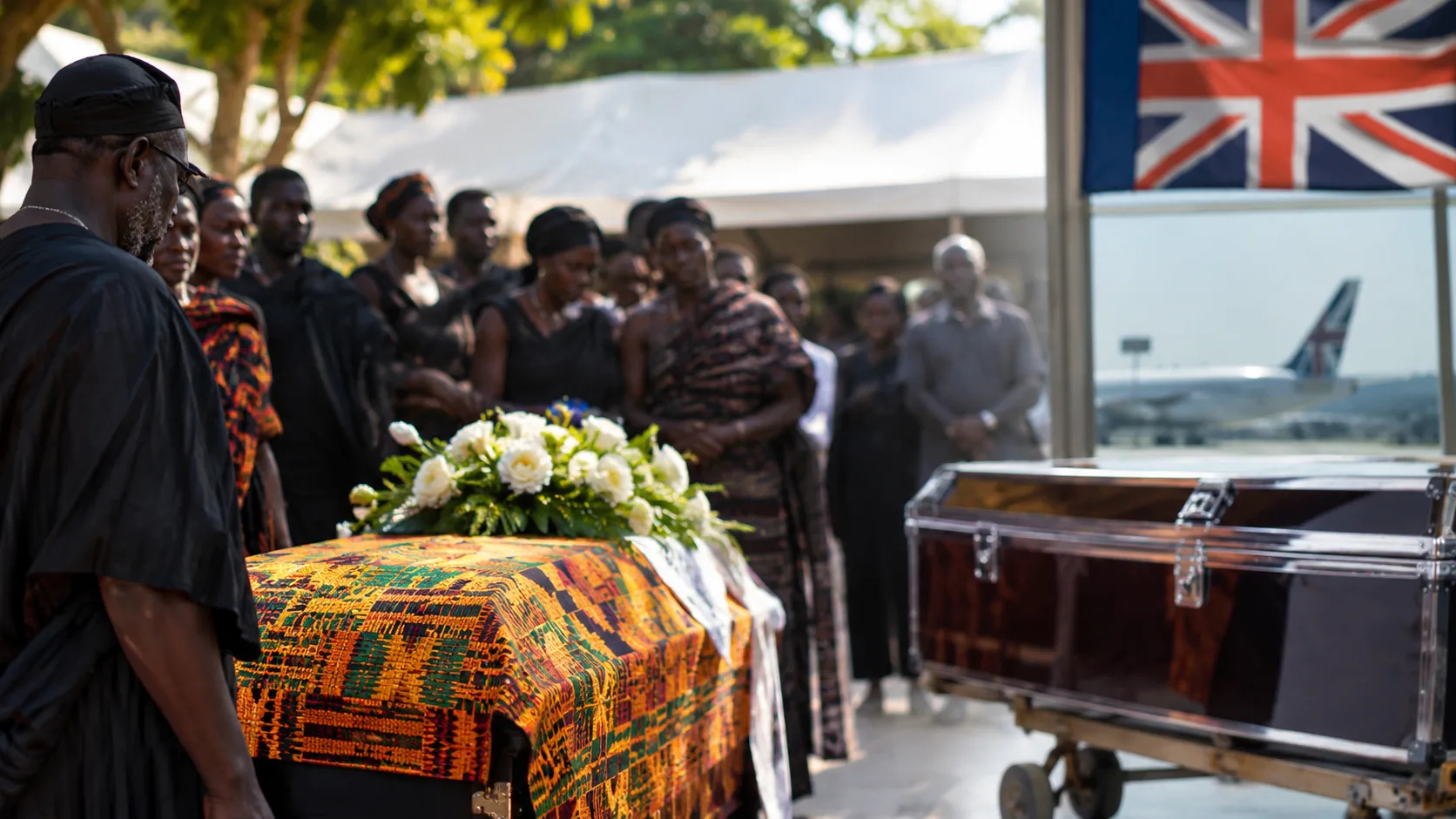
Key Takeaways
- Many African cultures believe a person must be buried on ancestral land to rest peacefully.
- Every body leaving England or Wales needs coroner permission, even after a natural death.
- From 9 November 2026, deaths in England and Wales are recorded electronically, and telephone registration is available.
- Embalming, a sealed coffin and destination country consular paperwork are standard requirements for African repatriations.
- Choosing an experienced international funeral director early prevents costly delays with airlines and embassies.
To repatriate a loved one from the UK to Africa, the death must be registered, the coroner must receive a Form 104 notice and release the body, and the deceased must be embalmed and placed in a hermetically sealed coffin. Consular approval from the destination country is also needed. Most African repatriations take 7 to 14 days.
Why Is Burial at Home So Important in African Cultures?
For millions of African families living in Britain, death raises a question that most UK funeral guides never address: where does this person belong? For many first-generation African migrants in the UK, the wish to be buried in the place of their birth runs deep, yet these communities often receive no official financial help with the costs.
Across much of the continent, burial is not simply a private farewell. It is the moment a person joins the ancestors, and it confirms their place within a family, a clan and a piece of land. In Ghana, the dead were traditionally laid to rest within family territory so that ancestral presence stayed woven into daily life. In Kenya, a burial site can even become evidence in land and inheritance matters, which is why decisions about the body carry such weight.
This is also why disagreements arise. A spouse in Manchester may prefer a UK burial while elders in Kumasi or Kisumu insist the body comes home. Understanding these customs helps families plan with respect and avoid painful conflict.
What Are the Main Traditional African Funeral Customs?
African funeral traditions are as diverse as the continent itself, but several regional patterns shape how repatriation is planned.
West Africa: Ghana, Nigeria, Sierra Leone and Côte d’Ivoire
Ghanaian funerals are among the most elaborate in the world. Families commonly keep the body for at least a week while preparations are made; a longer wait often signals a grander funeral, and guests are expected to give donations to help the family meet costs. Mortuaries, once foreign to Ghanaian custom, are now treated as an essential part of the funeral process, which suits repatriation because the body can be held safely on arrival. Families should also know that in Akan custom, the body is regarded as belonging to the wider family, while the children are expected to pay for the funeral without holding final authority over it.
In Nigeria, Igbo families traditionally bury men in their ancestral compound, while Yoruba families often hold a joyful celebration of life for elders, with relatives wearing matching aso ebi fabric. Christian wakes, church services and thanksgiving services are common across both communities. If your loved one is returning to West Africa, see our dedicated guides for repatriation to Nigeria, Ghana, Sierra Leone and Côte d’Ivoire.
East Africa: Kenya, Uganda, Rwanda and Ethiopia
Among the Luo of Kenya, burial must happen at the ancestral home rather than a public cemetery, and failing to bring the body home is considered a taboo that may invite misfortune. Rites include an all-night vigil called Budho and, after burial, a cleansing ceremony known as Tero Buru. The tradition remained visible in 2025, when former Prime Minister Raila Odinga’s body was flown home from India and buried at his ancestral home in Bondo, beside his father.
Ethiopian Orthodox families hold prayers and memorials on set days after death, including the fortieth day. Read more on UK to Kenya body repatriation, the documents needed for Uganda, and repatriation to Rwanda and Ethiopia.
Southern and Central Africa: Zimbabwe, South Africa, Zambia, Malawi and DR Congo
Shona families in Zimbabwe often hold kurova guva, a ceremony around a year after burial that welcomes the spirit home as an ancestor. In South Africa, many families hold an unveiling of the tombstone months later. Night vigils, communal singing and burial in the rural home village are common across the region. Explore repatriation to Zimbabwe, South Africa, Zambia, Malawi and DR Congo.
Muslim Families: Somalia, Senegal, Sudan and Northern Nigeria
Islamic tradition calls for washing, shrouding and burial as quickly as possible. Some burials need to take place within 24 hours of death for religious or cultural reasons, and some register offices can issue funeral paperwork before the death is formally registered. Tell your funeral director at the first call if speed is essential, so the medical examiner, coroner and airline can be contacted immediately. See our page on repatriation to Senegal.
How Does Repatriation From the UK to Africa Work?
The legal process in England and Wales follows a clear sequence.
1. Medical review and registration. A medical examiner reviews the cause of death and sends the paperwork to the register office. You must then register the death within 5 days of being contacted, or 8 days in Scotland, and weekends and bank holidays count. Registration rules have just changed: from 9 November 2026, deaths are recorded electronically, and families no longer sign a paper register, and telephone registration is now possible where the local service offers it. Start at GOV.UK: Register a death.
2. Coroner permission to leave England. Anyone moving a body out of England and Wales needs a coroner’s authority, even when the death was entirely natural. A Form 104 notice must be given to the coroner where the body lies, and removal cannot happen until four clear days after the coroner receives it. In urgent cases, the coroner may allow removal sooner, and in some areas the coroner issues a Form 103 within one to two working days; families should not book travel until the funeral director holds it. The legal basis is the Removal of Bodies Regulations 1954. In Scotland, the Procurator Fiscal issues a Furth of Scotland letter instead.
3. Embalming and coffin preparation. Airlines and African authorities expect full embalming and a hermetically sealed, zinc-lined coffin. View Harmony’s repatriation coffin requirements.
4. Consular approval. The destination country’s High Commission or Embassy in London must authorise entry. For DR Congo, for example, this includes a Consular Mortuary Certificate alongside the death and embalming certificates.
5. Air freight and arrival. The coffin travels as cargo, clears customs at the destination airport, and is collected by the receiving funeral home or family.
What Documents Do You Need for Repatriation to Africa?
Requirements vary by country, but most African repatriations need the following. Harmony’s documentation guide covers each one.
- A certified copy of the UK death certificate issued by the register office.
- The coroner’s Out of England permission confirming the body may legally leave.
- An embalming certificate signed by the qualified embalmer who prepared the deceased.
- A certificate confirming the deceased was free from infectious disease at death.
- The deceased’s original passport, which some consulates will cancel and return.
- Consular authorisation or an import permit from the destination country’s High Commission.
- A coffin sealing declaration and an air waybill issued by the airline or agent.
How Long Does It Take and How Much Does It Cost?
Most repatriations from the UK to Africa take between one and two weeks. Harmony’s guidance puts Nigeria at 7 to 14 days and DR Congo at 7 to 12 working days, depending on coroner involvement, consular approval and flight availability. Kenya is often quicker, at around five to ten days.
On cost, Harmony International’s Nigeria service starts at £1,750 plus flights, with London to Abuja flights estimated from £750, and covers collection, embalming, the coffin, documents and transport. Several other African destinations are listed from £2,500. Extra costs can include consular fees, upgraded coffins and onward road transport to a village. Learn what is included in a repatriation quote before comparing providers. Note that the FCDO cannot help with any repatriation costs, so check travel, life or community burial society cover early.
Can You Hold Traditional Rites in the UK Before the Flight?
Yes. Many families hold a viewing, prayer vigil, church service or community wake in the UK so that friends, colleagues and children born here can say goodbye. Harmony’s Services Before Send Off allow families to honour the person in Britain before the journey home, with dressing in traditional cloth, religious washing or a choir arranged where possible.
Common Mistakes Families Should Avoid
- Booking flights for mourners before the coroner has formally released the body.
- Assuming a natural death does not need coroner permission to leave England.
- Leaving family disagreements about burial location unresolved until after the death.
- Choosing a provider without direct experience of the destination country’s consulate.
- Forgetting that weekends and UK bank holidays can delay consular approvals.
Bringing Your Loved One Home With Dignity
Repatriation to Africa brings together two worlds: strict UK legal rules and deeply held traditions about family, land and the ancestors. Getting both right means acting quickly, keeping relatives on both continents informed, and working with specialists who understand the cultural meaning behind every step.
Harmony International has supported Congolese and other African families in the UK since 2013, managing coroner paperwork, embalming, consular approvals and flights to destinations across Africa, 24 hours a day. If someone you love has died and needs to go home, call +44 20 3026 4464, request a free repatriation quote, or contact the Harmony team now.
Frequently Asked Questions
How long does it take to repatriate a body from the UK to Africa?
Most repatriations take 7 to 14 days. The timeline depends on whether the coroner investigates, how quickly the destination High Commission approves paperwork, and cargo flight availability. Uncomplicated cases to countries like Kenya can finish in five to ten days.
Do I need coroner permission if the death was natural?
Yes. Every body leaving England or Wales needs coroner permission. Your funeral director submits Form 104, and removal can normally happen four clear days later, or sooner if the coroner agrees.
How much does repatriation from the UK to Nigeria or Ghana cost?
Harmony International’s services to African destinations start from £1,750 to £2,500 plus flight costs, with flights to Nigeria estimated from £750. Consular fees, coffin upgrades and onward transport may add to the total.
Is embalming required for repatriation to Africa?
Almost always. Airlines and African authorities expect full embalming for long-distance transport, along with a hermetically sealed, zinc-lined coffin and an embalming certificate.
Can I register a death by phone in England?
Since 9 November 2026, many register offices in England and Wales offer telephone registration, and some offer video. All registrations are now recorded electronically.
Can a Muslim burial still happen quickly if the body is going abroad?
Often yes. Tell the medical examiner and funeral director immediately. Coroners can shorten the four-day waiting period in urgent cases, and specialists can prioritise embalming exemptions or fast consular approval where the destination country allows.
Can I repatriate a body myself without a funeral director?
It is legally possible but very difficult, because airlines usually accept human remains only from known shippers. Read whether you can repatriate a body without a funeral director.
Where can I find official UK guidance?
Use GOV.UK: Register a death, GOV.UK: What to do after someone dies, the FCDO’s list of international funeral directors in the UK, and country pages such as GOV.UK: When someone dies in Ghana.
 Call us
 Email us