



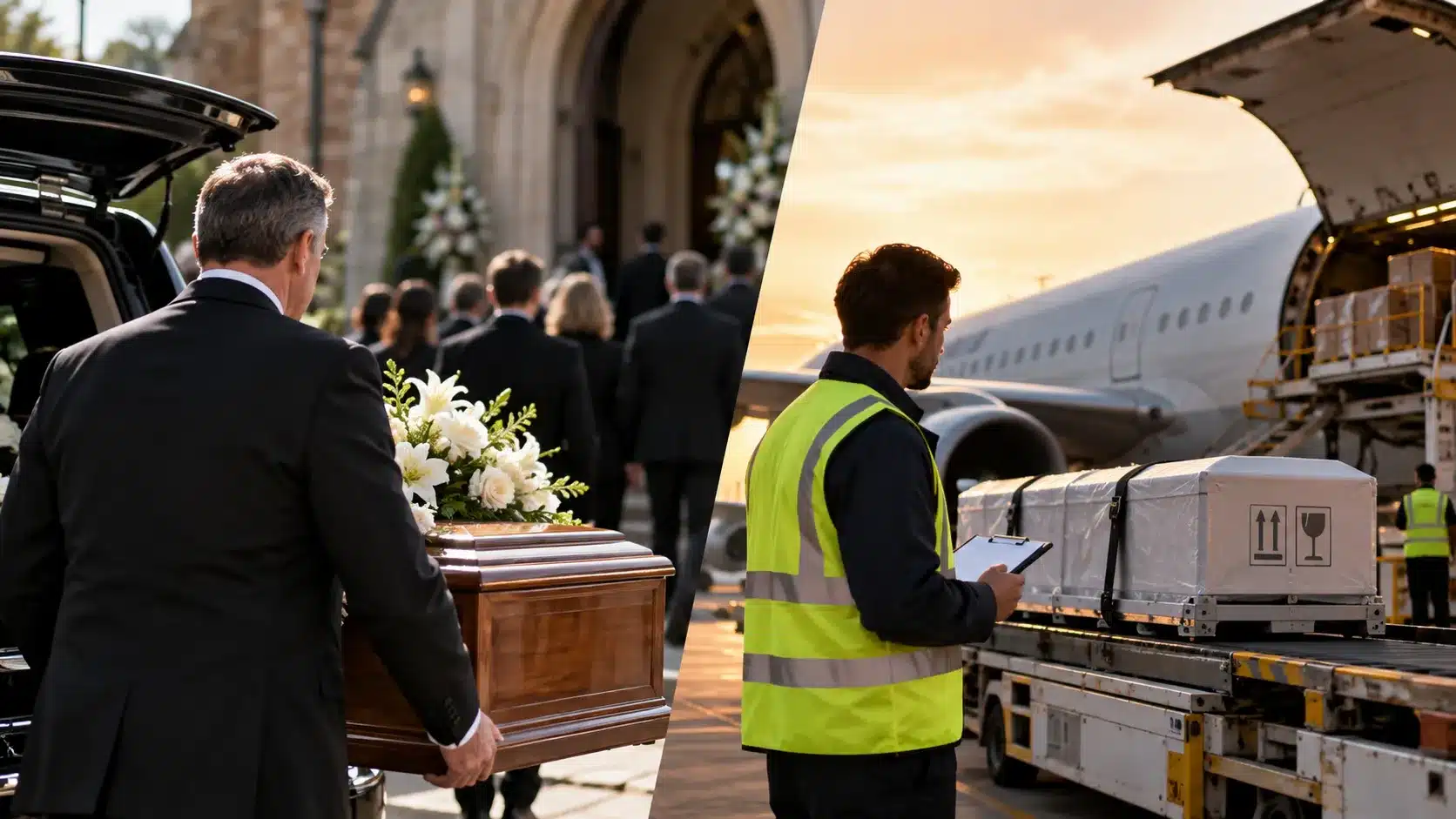
A local funeral director arranges and conducts funerals within the UK. An international repatriation specialist moves a person who has died across borders and manages the coroner permissions, embalming, sealed coffin, airline cargo booking, embassy approvals and customs clearance that this needs. Many families need both: the local team cares for the funeral, and the specialist handles the international journey.
Why families confuse the two
Both professions care for the deceased with dignity, and both speak to families at the worst possible time. The difference is the legal and logistical territory each one works in. A local firm works within one set of UK rules. A repatriation specialist works across two or more legal systems at once, with an airline in the middle.
That gap matters when a death happens abroad or when a family wants a funeral in another country. A well-meaning local firm may be excellent at services but unfamiliar with export certificates or cargo airline rules. Knowing who does what helps you avoid delays and unexpected bills.
What does a local funeral director do?
A local funeral director looks after the practical and ceremonial side of a funeral within the UK. This usually means collecting the person from a hospital, hospice or home, caring for them in a mortuary, advising on burial or cremation, supplying a coffin, booking the crematorium or cemetery, and coordinating the celebrant, flowers and cars. They also guide you through registering the death and paying third-party costs.
Regulation is worth understanding here. Funeral directors in England, Wales and Northern Ireland do not need specific qualifications or facilities such as refrigeration to operate unless they choose to join a trade body such as the NAFD or SAIF. Scotland’s statutory Funeral Director Code of Practice came into force on 1 March 2025. So membership of a trade body is a useful quality signal for any funeral provider you consider.
What does an international repatriation specialist do?
An international repatriation specialist, sometimes called an international funeral director, focuses on transferring remains between countries. At Harmony International, for example, the team coordinates with embassies, airlines, insurers and coroners on the family’s behalf to transfer a loved one safely across the world. Typical tasks include:
- Notifying the coroner and obtaining permission to move the body out of England and Wales, which some councils say should be requested at least four days ahead.
- Arranging embalming and a certificate of embalming, which many destination countries require before they accept remains.
- Supplying a zinc-lined, hermetically sealed coffin that meets airline and import rules for the destination.
- Securing embassy or consulate approvals and any health or cadaver certificates the destination country demands.
- Booking airline cargo space, arranging customs clearance and organising collection at the arrival airport.
Coroner permission must be obtained for every body moved out of England or Wales, not only for deaths reported to the coroner. A specialist handles that step routinely.
What paperwork is involved?
Sending someone out of the UK. In England and Wales, you tell the coroner by completing a Form of Notice (Form 104) and include the Certificate for Burial or Cremation already issued, after which the coroner confirms when the body can be moved. A freedom from infection certificate and a certificate of embalming are typically needed too. Some countries also ask for a cadaver certificate, usually issued by the Environmental Health officer of the local council. Scotland and Northern Ireland have their own procedures, so ask your provider to confirm the correct route.
Bringing someone home to the UK. You need a certified English translation of the death certificate, permission to remove the body from the country where the person died, and you must tell a coroner in England if the death was violent or unnatural. You do not have to register the death in the UK, and you do not need a permit to bring ashes into the country. If the body is repatriated, a post-mortem may take place in the UK even if one has already happened abroad. The government’s guidance on what to do after a British national dies abroad explains each step in detail.
How do costs and timelines compare?
A local funeral is usually cheaper and quicker because it needs no international transport. Repatriation costs more because of the extra preparation and the flight. Costs are often high because the body may not be able to travel on a scheduled airline service.
To give a sense of line items, one national provider’s 2023 booklet listed embalming for repatriation at £200, zinc lining of a coffin at £350 and coffin wrapping at £150, before airline and other charges. Totals vary by destination. One guide to India to UK repatriation puts typical full body costs between £3,800 and £6,800. Treat any figure as a guide and ask for a written quote.
On timing, one provider states it takes seven to ten days on average. Harmony International’s guide says the paperwork stage generally takes five to ten working days, depending on coroner processing, embassy approvals, embalming and flight availability. Coroner enquiries or flight disruption can add time.
Who pays? The FCDO will not pay burial, cremation or repatriation expenses. Government Funeral Payments are also unable to help with repatriation costs. If the person had travel insurance, the insurer will normally have a standing agreement with an international funeral director in the UK to arrange the repatriation. Call the insurer before you appoint anyone, because instructing a firm yourself first can complicate a claim.
How to check credentials
Because many funeral firms are unregulated in England, Wales and Northern Ireland, ask for evidence of standards. The FCDO’s list of UK-based international funeral directors shows regulatory affiliations such as NAFD, SAIF, IATA, FIAT-IFTA and BIE. The FCDO says it does not endorse or recommend any provider on that list. Use it as a starting point and do your own checks. Good questions include:
- Does the quote include embalming, a zinc-lined coffin, airline charges, embassy fees and customs clearance at the destination airport?
- Is the firm a member of a recognised body such as the NAFD or SAIF, and how are complaints handled?
- Will you have one named contact, and does the team answer calls around the clock?
- How will they keep you updated if a coroner enquiry or flight cancellation causes a delay?
Do you need both?
Often yes, but not always as two separate firms. If the funeral will happen entirely abroad, a repatriation specialist can usually manage the whole process with an overseas partner. If you want a UK service first, you can combine the two. Harmony International’s Ireland page, for example, mentions a bespoke package that includes a UK service before repatriation out of the UK.
If the person is being cremated and the ashes travel, the process is simpler. Repatriating ashes avoids the cost of embalming and a zinc-lined coffin. Some families choose this route when budget or travel time is tight, but only you can decide what suits your family’s faith and wishes.
Choose the right expert for the journey
A local funeral director is the right choice when the funeral stays in the UK. An international repatriation specialist is the right choice when a person must cross a border, because the legal, medical and airline requirements are specialist work. If you are unsure, start with the specialist, since they can tell you quickly whether your situation needs one or both.
Harmony International offers a 24-hour international repatriation service, with transfers into and out of the UK. If you need support, you can tell the team about a death or request a call back through the homepage. Call Harmony International today for compassionate, clear guidance at every step.
Frequently asked questions
- What is the main difference between a funeral director and a repatriation specialist?
A funeral director arranges funerals within the UK. A repatriation specialist transports the deceased between countries and manages the export, embalming, coffin, airline and embassy requirements.
- Can my local funeral director arrange repatriation?
Some can, and some larger firms have international divisions. Ask whether they handle coroner notices, embalming certificates, sealed coffins and airline cargo bookings regularly.
- How long does repatriation from the UK take?
Providers commonly quote around five to ten working days, depending on coroner processing, embassy approvals, embalming and flights. Complex cases can take longer.
- Do I need to register a death abroad in the UK?
No. The government says you do not have to register the death in the UK, though you can apply for a consular death registration if you want a UK record.
- Is a zinc-lined coffin always required?
A zinc-lined coffin is needed for transport to most countries. Your specialist will confirm the exact rule for your destination.
- Is it cheaper to repatriate ashes?
Usually yes, because embalming and a sealed coffin are not needed. You do not need a permit to bring ashes into the UK. Airline and destination rules still apply, so check them first.
 Call us
 Email us