



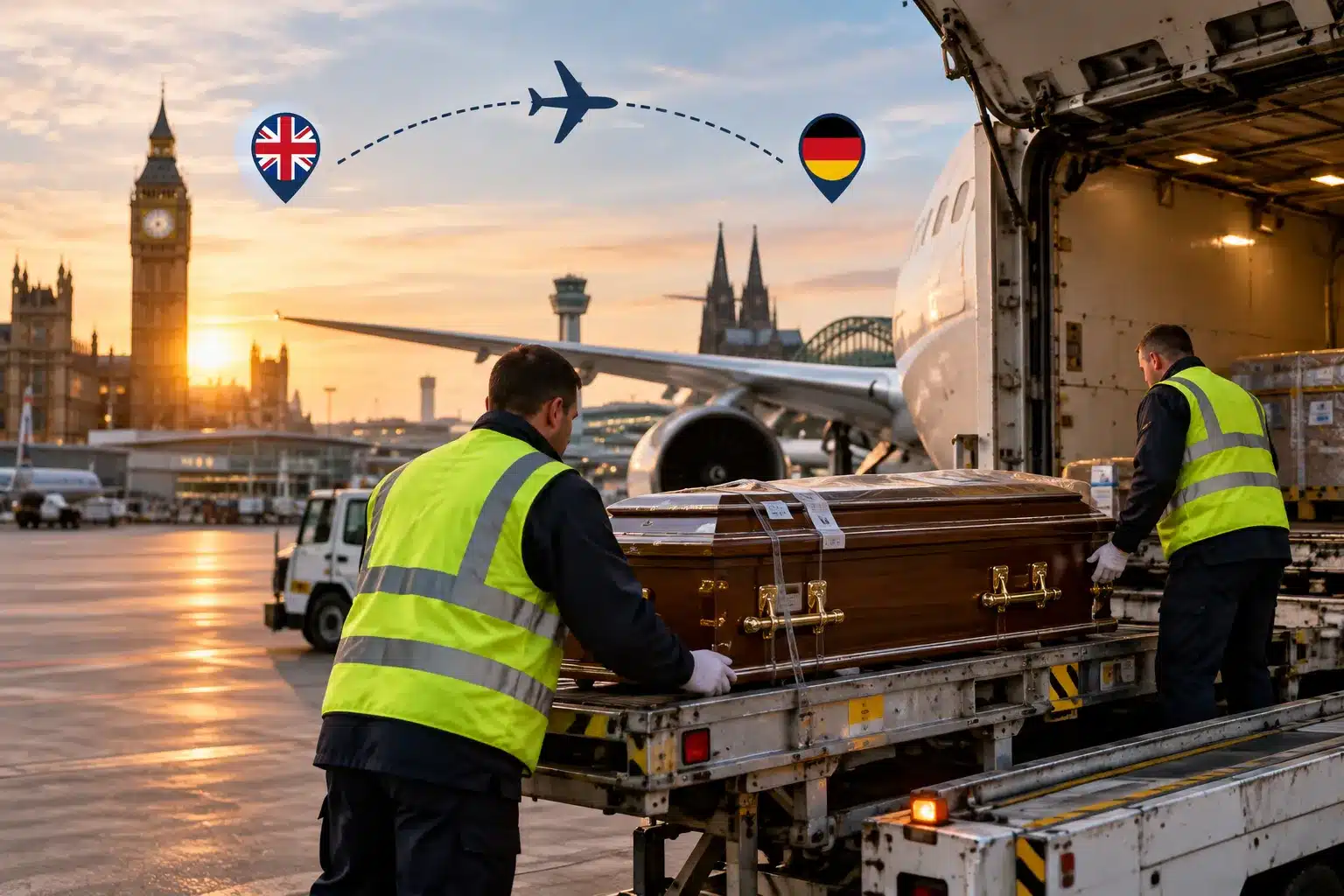
Repatriating a deceased loved one from the UK to Germany typically takes between seven and fourteen days, although some straightforward cases are completed in as little as five to seven days. The process brings together UK death registration and coroner formalities, a German import document called the Leichenpass, a hermetically sealed coffin, and coordination with a receiving German funeral director known as a Bestatter. This guide walks through exactly what needs to happen on both sides, the specific German documents involved, and what families should expect at each stage.
The UK Side: What Has to Happen Before the Body Can Leave
Before any repatriation to Germany can proceed, a set sequence of UK steps must be completed. The death must be registered with the local UK registrar, and certified copies of the death certificate obtained. If the death was sudden, unexplained, or the deceased had not recently been seen by a treating doctor, the coroner must be notified, and this can add time to the overall process. The German consulate or embassy in London should also be informed, since it can confirm exactly which German documents will be required for the specific case. Once these steps are underway, a repatriation specialist can begin arranging embalming, the coffin, and the flight.
The German Side: Documents and Terms Families Should Know
Germany’s death registration system uses several distinct documents that do not have a direct UK equivalent, and understanding them helps families follow what their repatriation provider is actually arranging.
- The Sterbeurkunde is the official German death certificate issued by the local Standesamt, or civil registry office.
- The Totenschein is the medical certificate confirming cause of death, completed by an examining doctor.
- The Leichenpass, sometimes called a corpse passport, is the specific document required for the international transport of remains into Germany.
- The Gesundheitszeugnis is a freedom from infection certificate confirming the deceased did not have a notifiable infectious disease.
On the receiving side, the family typically works with a Bestatter, the German term for a funeral director, who coordinates local requirements with the Standesamt and confirms the exact paperwork needed for the specific German state and city involved.
Step by Step: How the Process Works
- Register the death in the UK and obtain certified copies of the death certificate without delay.
- Notify the coroner if required, since this determines how quickly the remaining steps can proceed.
- Instruct a repatriation specialist experienced with UK to Germany cases to begin document preparation.
- Arrange embalming and place the deceased in a hermetically sealed coffin meeting German entry standards.
- Obtain the Leichenpass and any other documents specified by the German consulate in London.
- Book a confirmed flight with an airline accepting human remains cargo to a suitable German airport.
- Complete customs clearance on arrival, which is generally straightforward given exemptions for coffins and urns.
- Hand over the deceased to the receiving Bestatter in Germany for burial or cremation arrangements.
Coffin and Preparation Requirements
German regulations mandate the use of a hermetically sealed coffin that complies with international air transport standards, and embalming is generally required as part of this preparation. Many UK repatriation providers offer approved options such as oak veneer caskets, which combine a properly sealed lining with a presentable finish suitable for a viewing or service once the coffin arrives in Germany.
Which German Airports Can Receive Repatriated Remains
Several German airports are equipped with the customs and cargo facilities needed to process incoming human remains, giving families flexibility depending on where the funeral will take place.
- Frankfurt and Munich are among the busiest and most experienced airports for handling international repatriations.
- Berlin, Stuttgart, Cologne, Dortmund, Dusseldorf, and Bremen also have the required facilities in place.
Typical Timeline and Costs
Most cases are completed within seven to fourteen days, though some providers report straightforward cases finishing in as little as five to seven days when there is no coroner involvement and documentation is provided promptly. Costs depend on the destination city in Germany, the airline used, the weight of the coffin and deceased, and any additional funeral services requested, so families should expect a tailored quote rather than a single fixed price across all cases.
Customs and Duty Considerations
Germany applies a specific customs duties exemption for coffins containing the deceased, urns carrying ashes, and customary accompanying items such as flowers and wreaths. This generally makes the customs side of the process more straightforward than families expect, provided the correct documentation, including the Leichenpass, accompanies the coffin on arrival.
Cremation Versus Burial in Germany
Cremation is widely available across Germany, but families should be aware that German law traditionally restricts what can be done with ashes far more than UK law does. Under long standing cemetery compulsion rules, known as Friedhofszwang, ashes generally must be interred in a licensed cemetery rather than scattered freely or kept at home, although some German states have relaxed this in specific circumstances, such as designated burial forests or sea burial in certain regions. Because these rules vary by state, it is worth confirming the current position with the receiving Bestatter before finalising plans.
Getting Support on Both Sides of the Journey
Because this process involves UK coroner formalities, German civil registry requirements, and consulate coordination all at once, working with a provider experienced in both systems reduces the risk of delay. Harmony International provides a complete repatriation service from the UK to Germany, preparing all paperwork to meet both UK and German regulations and offering approved hermetically sealed coffins for safe transport.
If you are arranging a repatriation from the UK to Germany now, contact Harmony International for twenty four hour support, or request a free quote to get an accurate cost and timeline for your family’s situation.
Frequently Asked Questions
How long does repatriation from the UK to Germany take?
Most cases take between seven and fourteen days, though straightforward cases without coroner involvement can sometimes be completed in five to seven days.
What is a Leichenpass and why does Germany require it?
A Leichenpass, or corpse passport, is a specific German document required for the international transport of remains, confirming the deceased’s identity and clearance for entry into Germany.
Is embalming compulsory for repatriation to Germany?
Yes, German regulations generally require embalming alongside a hermetically sealed coffin for the international transport of remains.
Which German airports can accept repatriated remains?
Frankfurt, Munich, Berlin, Stuttgart, Cologne, Dortmund, Dusseldorf, and Bremen all have the customs and cargo facilities required.
Can ashes be scattered freely in Germany like they can in the UK?
Generally not. German cemetery compulsion rules usually require ashes to be interred in a licensed cemetery, though some states allow limited exceptions such as burial forests.
Who receives the deceased on the German side?
A German funeral director, known as a Bestatter, receives the deceased and coordinates local burial or cremation arrangements with the Standesamt. Harmony International liaises directly with the receiving Bestatter on the family’s behalf.
 Call us
 Email us