



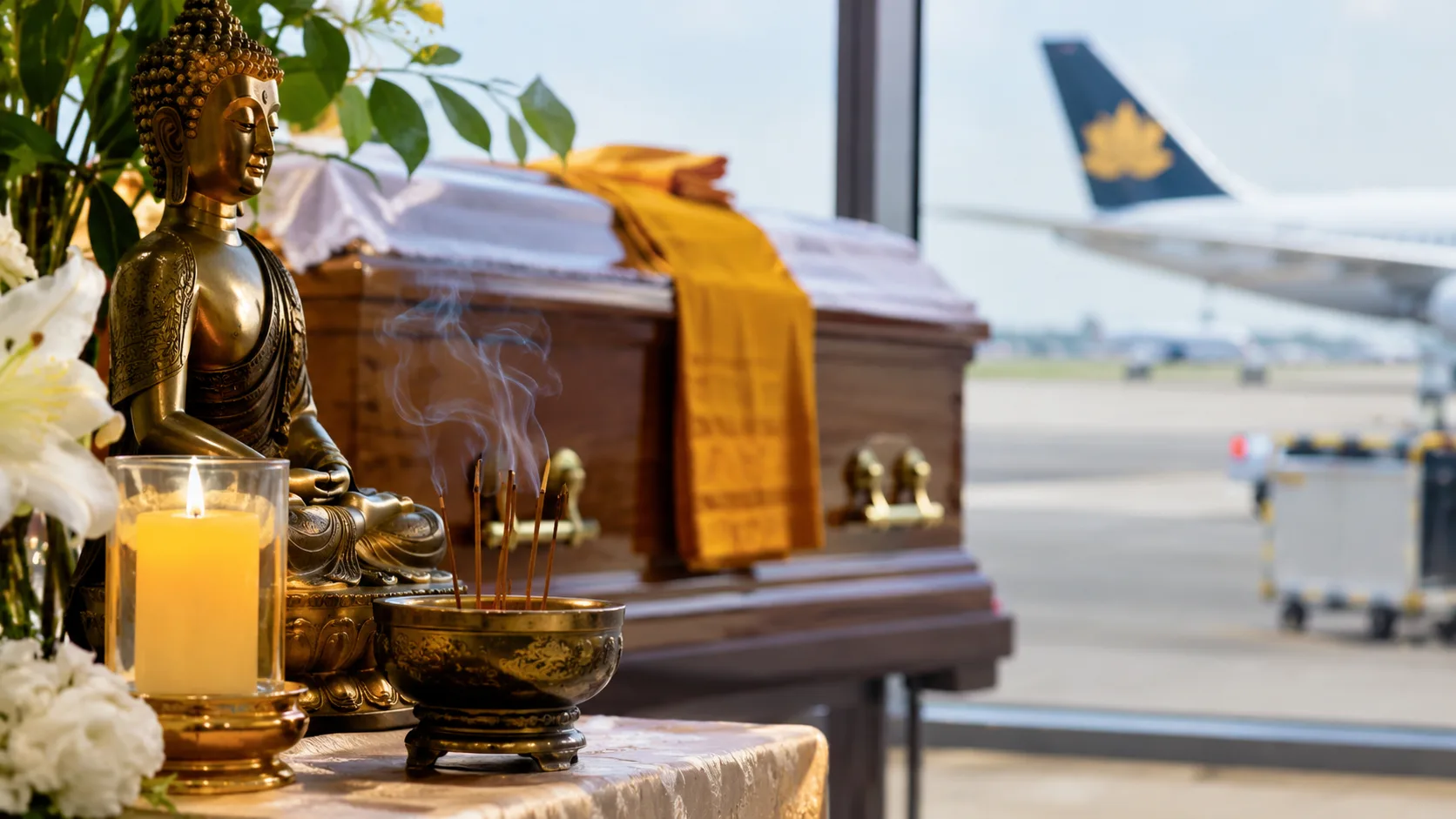
Key Points at a Glance
- Practice varies by Buddhist tradition, so consult your monk or lama before any arrangements are made or timings are fixed.
- Many Buddhist families ask for the body to remain undisturbed for hours or even up to three days.
- Embalming and a sealed coffin are normally required for air transport of a body, which can conflict with some wishes.
- Cremating in the UK and repatriating the ashes is simpler, avoids embalming, and is widely chosen by Buddhist families.
- Memorial rites on set days after death, especially the 7th and 49th, can be held in the UK and at home.
Buddhist repatriation from the UK means returning the body or ashes of a Buddhist who has died in Britain to their country of origin, while respecting the rites of their tradition. There is no single Buddhist rule, because practice differs between Theravada, Mahayana and Tibetan communities, so the first step is to speak with the family’s monk, nun or lama. Legally, the process needs death registration, the coroner’s permission to remove a body from England and Wales, and destination country paperwork. A body also needs embalming and a hermetically sealed coffin for air travel, so many families cremate in the UK and carry the ashes home. A body repatriation typically takes seven to fourteen days.
Why Buddhist Practice Shapes the Repatriation Plan
Buddhism has no central authority that sets one funeral procedure, so families from Thailand, Sri Lanka, China, Vietnam, Japan and Tibet may follow quite different customs. What unites them is a belief that death is a transition, that the first hours matter, and that chanting and merit-making by the living can help the person who has died. Repatriation adds legal steps that were never part of traditional practice, so the aim is to fit them around the family’s rituals. Raising this on the first call to the funeral director prevents avoidable distress later.
Buddhist Traditions Compared
The table below summarises how the three main traditions commonly approach death and memorial rites. It is a general guide, and individual families, temples and teachers vary.
| Tradition | Common communities | Typical practices | Memorial rhythm |
| Theravada | Thailand, Sri Lanka, Myanmar, Cambodia, Laos | Chanting in Pali, merit making, offering cloth and food to monks, often several days of rites before cremation | Days 3, 7, 49 and 100 are commonly marked |
| Mahayana | China, Vietnam, Japan | Chanting of sutras in Chinese or Japanese, family recitation, cremation often follows the funeral service | Weekly rites across the 49 days |
| Tibetan (Vajrayana) | Tibet, Nepal, Bhutan and Himalayan communities | Body often left undisturbed, phowa and Bardo Thodol readings, a lama may choose an auspicious day | Prayers on the 7th, 14th, 21st and every seventh day to the 49th |
The Undisturbed Period and Why Timing Matters
Many Buddhists, particularly in the Tibetan tradition, believe consciousness may not leave the body immediately and that handling or commotion can be harmful. Guidance from the Samye Ling Tibetan Buddhist centre asks that the body is left undisturbed, and other sources describe periods ranging from a few hours up to three days. This matters in practice, because hospital mortuaries, coroners and funeral directors will normally want to move quickly. Tell the hospital team and your funeral director immediately if your family wishes for the body to rest, and agree with your teacher how long and where, so that collection, embalming and registration can be scheduled around it as far as the law allows.
Embalming: A Sensitive Question
Airlines and receiving countries almost always require embalming and a hermetically sealed, zinc-lined coffin for the international transport of a body. Some Buddhists record a wish not to be embalmed, and the Samye Ling funeral form includes that option, so this can create real tension. There is no universal Buddhist ruling, and this guide is not a substitute for your teacher, so ask them directly. Families commonly consider three routes: delaying embalming until the undisturbed period has passed, asking a lama whether embalming for necessity is acceptable, or cremating in the UK and repatriating ashes instead. Harmony International explains the coffin standards in its guide to wood versus metal coffins for repatriation.
Rituals Before, During and After Repatriation
Chanting is central to almost every Buddhist funeral, and merit making is a common thread. Theravada communities often offer food and robes to monks in the name of the deceased, while Chinese, Vietnamese and Tibetan families hold rites every seventh day for 49 days, the period many believe is spent in the intermediate state before rebirth. Thai families hold daily rites for three, five or seven days before cremation at a temple, while Japanese families typically hold the funeral service first and cremate afterwards. Families can build these rites into the plan in several ways.
- Invite a monk, nun or lama to chant at the home, hospital chapel or funeral home before the coffin leaves.
- Ask your local Buddhist centre or temple to dedicate prayers and light candles during the 49 days after death.
- Arrange a UK memorial rite before departure, then confirm which rites the temple at the destination will hold.
- Name the receiving temple, monk or funeral director in advance so that rites can begin as soon as the remains arrive.
Step by Step: How Buddhist Repatriation Works
- Contact your monk, nun or lama and agree how long the body should rest undisturbed and what rites are needed.
- Register the death with the UK registrar and obtain several certified copies of the death certificate.
- Notify the coroner and obtain permission to remove the body from England and Wales, allowing the required notice period.
- Instruct a repatriation specialist and decide together whether to repatriate the body or cremate and carry the ashes.
- Complete embalming and sealing for a body, or cremation and certification for ashes, once the agreed rest period ends.
- Obtain any permit or letter required by the destination embassy, and legalise UK documents where necessary.
- Book the flight, arrange collection abroad, and confirm the temple or funeral director who will lead the rites.
Documents You Will Usually Need
- A UK death certificate from the registrar, with several certified copies for the authorities and the receiving country.
- The deceased’s passport, which providers use to support applications, and an expired passport is often acceptable.
- The coroner’s permission to remove a body from England and Wales, following the formal notice of intention to remove it.
- An embalming certificate and freedom from infection certificate for a body, or a cremation certificate for ashes.
The first step follows the standard process for registering a death on GOV.UK, and some countries require documents to be legalised by the Foreign, Commonwealth and Development Office before they are accepted. Requirements differ by destination, so always confirm with the relevant embassy through your provider.
Ashes or Body: Choosing the Right Path
Cremation is common across Buddhist traditions and offers real advantages for repatriation. There is no embalming, no sealed coffin and no cargo booking, so the process is usually simpler and cheaper, and the family can complete UK rites without time pressure. Taking the body home can feel more appropriate where the tradition expects several days of rites with the coffin present, as in Thai funerals. Neither choice is more correct, so the decision should rest on the family’s tradition, the teacher’s advice, and the practicalities of the destination.
Planning Ahead and Getting Support
Many Buddhist centres encourage members to record their funeral wishes in advance, including whether the body should rest undisturbed, whether embalming is acceptable, and which prayers to hold. When a death does occur, an experienced specialist can handle the coroner, consulate, airline and legal documents while you focus on the rites. Harmony International is a UK based repatriation specialist with a multilingual team that works with families of many faiths, and it respects faith traditions and funeral rites throughout.
If your family is searching for Buddhist repatriation services UK, contact Harmony International for twenty-four-hour support, or request a free quote for a clear cost and timeline that respects your family’s wishes.
Frequently Asked Questions
What is Buddhist repatriation from the UK?
It is the return of a deceased Buddhist’s body or ashes from the UK to their country of origin, arranged around the rites of their tradition and the legal requirements of both countries.
Should the body be left undisturbed before repatriation?
Many Buddhists, especially in the Tibetan tradition, ask for the body to rest undisturbed for hours or up to three days. Tell the hospital and funeral director immediately and agree the timing with your teacher.
Is embalming allowed for Buddhist repatriation?
There is no single Buddhist ruling. Airlines normally require embalming for a body, so families often ask their teacher for guidance or choose cremation and repatriate the ashes.
Can ashes be repatriated instead of a body?
Yes. This is widely chosen because it avoids embalming and a sealed coffin. You will need a death certificate, a cremation certificate and usually a funeral director’s declaration.
What is the 49-day period in Buddhism?
Many Mahayana and Tibetan Buddhists believe consciousness spends up to 49 days in an intermediate state, with prayers every seventh day. Many Theravada communities keep the same days for merit-making.
How long does Buddhist repatriation from the UK take?
A body repatriation typically takes seven to fourteen days, longer if the coroner is involved or the family asks for an extended rest period. Ashes can often be arranged more quickly.
Who can arrange Buddhist repatriation from the UK?
A specialist repatriation provider manages the legal paperwork, embalming or cremation, flights and the receiving funeral director. Harmony International can talk through your tradition’s requirements and explain exactly what is included.
 Call us
 Email us