



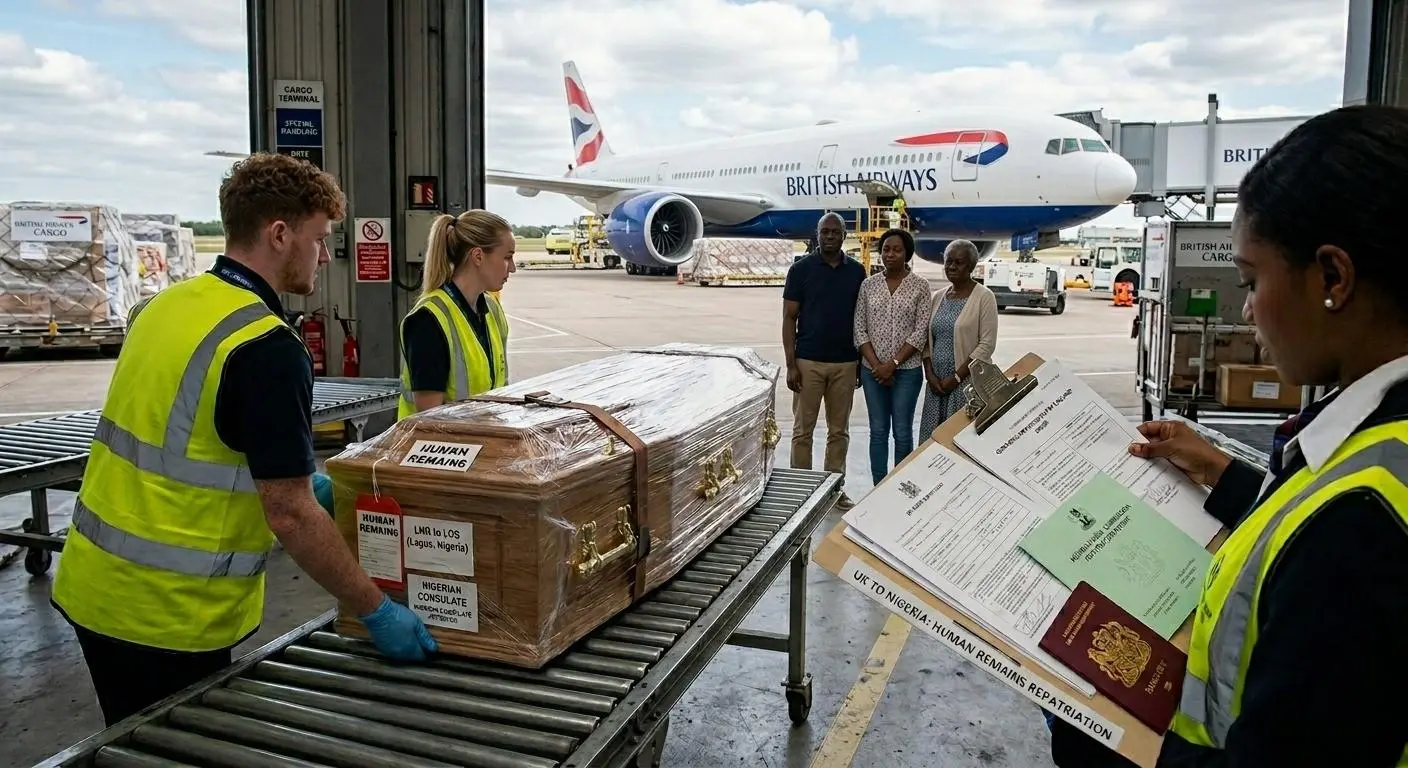
Losing a loved one is never easy. When that loss happens far from home, the responsibility of arranging their return to Nigeria can feel overwhelming. For the large Nigerian diaspora living in the United Kingdom, repatriation is a deeply personal and culturally significant process.
It involves navigating two countries’ legal systems, multiple government bodies, airline freight regulations, and tight timelines, often while grieving. This guide walks you through every stage of sending human remains from the UK to Nigeria, drawing on current official government guidance, so your family can focus on what matters most.
Step 1: Register the Death and Obtain a UK Death Certificate
Before any repatriation can begin, the death must be formally registered in the United Kingdom. If the person died in England or Wales, the death must be registered at the local register office, typically within five days. The registrar will issue a death certificate and a Certificate for Burial or Cremation (the green certificate). You will need multiple certified copies of the death certificate, as different government bodies and airlines will each require one. It is worth requesting at least five certified copies at the time of registration.
If the death occurred under unexpected, violent, or unexplained circumstances, a coroner will be involved and may order a post-mortem examination before releasing the body. The coroner’s involvement can extend the timeline, so engage a specialist funeral director as soon as possible to manage the process alongside you.
Step 2: Apply for the Coroner’s Out of England Certificate
This is a critical legal step that many families are unaware of. Before a body can be removed from England, you must notify the local coroner by completing Form 104, formally titled the Form of Notice to a Coroner of Intention to Remove a Body out of England. According to Manchester City Council’s Coroner’s Office guidance, if the death is not already under investigation and the application is approved, the coroner will issue Form 103 to your funeral director, granting permission to move the body. This typically takes one to two working days. You must not book flights or make shipping arrangements until your funeral director has received Form 103.
If the death is being investigated, the process takes longer, especially if a post-mortem is required. In Scotland, the Procurator Fiscal or Death Certification Review Service handles this process, and the rules differ from those in England and Wales.
Step 3: Contact the Nigerian High Commission in London
The Nigerian High Commission in London is the central authority for issuing a burial transit permit, which grants permission for human remains to enter Nigeria. According to the official requirements published by the Nigeria High Commission in London, the following documents must be submitted:
- Four certified copies of the UK death certificate (if the certified copies do not show a cause of death, a letter from the attending physician stating the cause and confirming it was non-contagious is required)
- Burial permit with raised seal
- Letter of embalming on funeral home letterhead, confirming the remains were placed in a metal sealer casket
- Letter of non-contagious disease from a state or county health official, signed and notarized, stating the deceased did not die from a communicable disease
- Separate notarized statement from the funeral home confirming the casket contains only the remains of the deceased
- Passport of the deceased
- A metal sealer casket and an outer wooden box (no inner liner required)
- A formal letter from the funeral home requesting the High Commission to issue a shipment permit
- A waiver for the repatriation of the corpse from the Federal Ministry of Health, Port Health Services, Abuja
The Federal Ministry of Health in Nigeria requires a waiver before human remains are repatriated. A formal request letter must be sent to the Honourable Minister of Health in Abuja, detailing the date, place, cause of death, and age of the deceased. Your funeral director or a specialist repatriation company can assist with this correspondence.
Step 4: Embalming and Coffin Requirements
Embalming is not optional. According to GOV.UK guidance published by the Foreign, Commonwealth and Development Office (FCDO), the body must be embalmed and placed in a metal casket before it can be transported to Nigeria. Embalming preserves the body during the journey and is a legal requirement for international air freight. The casket must be a sealed metal sealer, placed inside an outer wooden box. The inner liner is not required.
A certified embalming certificate must accompany the remains. This certificate, prepared by the funeral director, confirms how the embalming was carried out and must be included in the documentation travelling with the coffin. Any upgraded coffin placed inside the required transport casket is a matter for the family to arrange separately, and specialist repatriation providers can offer a range of options.
Step 5: Booking the Air Freight and Choosing an Airport
Human remains are transported as air cargo, not as passenger luggage. Only certain Nigerian airports are authorised to receive repatriated human remains. The three primary airports equipped with the necessary customs clearance facilities are Murtala Muhammed International Airport in Lagos, Nnamdi Azikiwe International Airport in Abuja, and Port Harcourt International Airport. Airlines operating cargo routes to Nigeria from the UK include British Airways and Virgin Atlantic, typically departing from London Heathrow. Flight costs to Abuja from the UK start from around 750 pounds, though this varies depending on the weight of the casket and the airline.
Your repatriation company will handle the airway bill and freight booking on your behalf. You should not contact airlines directly without the support of a licensed funeral director, as specific cargo handling procedures apply to human remains.
Step 6: Documents That Travel with the Coffin
A comprehensive set of documents must accompany the remains on the flight. These are inspected by customs officials upon arrival in Nigeria. The standard document pack includes:
- UK death certificate (certified copies)
- Passport of the deceased
- Coroner’s Out of England certificate (Form 103)
- Freedom from infection certificate (confirming the area was free from epidemic disease)
- Embalming certificate
- Burial transit permit issued by the Nigerian High Commission
- Funeral director’s statement confirming the casket’s contents
- Waiver from Nigeria’s Federal Ministry of Health, Port Health Services
Both originals and photocopies of all documents are required. It is advisable to keep a full copy set for the family as well.
Step 7: Customs Clearance and Collection in Nigeria
Once the remains arrive at the Nigerian airport, a designated representative, typically a funeral home or family member in Nigeria, must be present to handle customs clearance. This is a step that requires planning ahead. You will need to appoint a local Nigerian funeral director or an agent with authority to clear goods through customs. Clearance fees apply and vary by airport. Your UK-based repatriation provider may have contacts who can assist with this in Lagos, Abuja, or Port Harcourt.
If the family plans to hold a viewing or service before the burial, arrangements should be made in advance with the receiving funeral home in Nigeria, as the timeline between arrival and burial can vary.
Costs and Timeline
Total repatriation costs from the UK to Nigeria typically include a base repatriation service fee, the airfreight charge, third-party government fees, and optional upgrades. The overall outlay generally starts from around 2,500 pounds at the lower end and can reach 4,000 pounds or more depending on coffin selection, airline, and destination airport. Airfreight alone to Lagos or Abuja starts from approximately 750 pounds. Third-party charges such as embalming, documentation fees, and airport handling are added on top.
In terms of timeline, a repatriation from the UK to Nigeria typically takes between seven and fourteen days from the date of death registration, assuming no coroner investigation is ongoing. If a post-mortem is required or documentation is delayed, the process can take longer. Engaging a specialist repatriation provider immediately after the death is the single most effective step for shortening the timeline.
Travel Insurance and Financial Planning
According to GOV.UK guidance from the FCDO, if the deceased had travel or life insurance, the insurance company should be contacted as soon as possible. Insurers may appoint funeral directors in both the UK and Nigeria and may cover the cost of repatriation, legal fees, and translation costs. If there was no insurance, the family will need to bear all costs directly. Pre-paid repatriation plans are available from some specialist providers, allowing individuals to arrange and pay for repatriation at today’s prices in advance.
Frequently Asked Questions
How long does it take to send human remains from the UK to Nigeria?
Most repatriations are completed within seven to fourteen days of death registration, provided there are no coroner investigations or documentation delays. If a post-mortem is ordered or there are complications with any of the permits, the process may take longer.
Is embalming mandatory for repatriation to Nigeria?
Yes. GOV.UK guidance confirms that the body must be embalmed and placed in a metal casket before it can be transported from the UK to Nigeria. This is a legal requirement of both UK and Nigerian authorities, and the embalming certificate is a required document.
Which airports in Nigeria accept repatriated human remains?
Three airports are authorised to receive human remains with the required customs clearance facilities: Murtala Muhammed International Airport in Lagos, Nnamdi Azikiwe International Airport in Abuja, and Port Harcourt International Airport.
Does the deceased need a passport for repatriation?
The Nigerian High Commission in London requires the passport of the deceased as part of the permit application. An expired passport is acceptable. If a passport is not available, contact the repatriation provider or the High Commission directly to discuss alternative documentation.
Can cremated ashes be sent to Nigeria instead?
Yes, cremated ashes can be sent to Nigeria by air freight, though this can be costly. You will need a death certificate, cremation certificate, and must follow Nigerian regulations on receiving ashes. GOV.UK advises checking with your funeral director before sending ashes by post or courier, as this may not be permitted in all circumstances.
Who can help with the documentation?
A specialist repatriation company or international funeral director is best placed to manage the full documentation process, including obtaining the coroner’s Out of England certificate, liaising with the Nigerian High Commission, and preparing all documents that travel with the remains. You should not attempt to manage the paperwork independently, as errors can cause significant delays.
Do I need to register the death again in the UK after repatriation?
If the person died in the UK, the death will already have been registered here before repatriation. GOV.UK notes that you do not need to register a UK death again, but you may need to notify various UK government bodies using the Tell Us Once service, available through your local register office. This allows you to inform most government organisations of the death in a single step.
Final Thoughts
Repatriating a loved one from the UK to Nigeria is a process that touches every part of life: legal, logistical, financial, and deeply emotional. The requirements are detailed and the paperwork is significant, but with the right support, the process can be managed with dignity and care.
Engaging a specialist repatriation provider early, checking your insurance policy immediately, and contacting the Nigerian High Commission in London as soon as possible are the three most important first steps. Harmony International can help you out with this and offers 24/7 support precisely because families in these moments need consistent, expert guidance. You do not need to navigate this alone.
Sources:
GOV.UK (FCDO): When someone dies in Nigeria
GOV.UK: What to do after a British national dies abroad
Manchester City Council Coroner’s Office: Removing a body out of England
Newham Council: Repatriation of bodies
Pages You Might Like:
UK repatriation services, Destinations We Repatriate, Into the UK, What to do when someone dies, Coffins we offer
 Call us
 Email us