



When a loved one dies far from home, the instinct for most families is immediate: bring them back. Repatriation, the process of transporting the remains of a deceased person across international borders, is an act of profound love. It is also, for many families, an unexpectedly large financial burden.
Questions about cost arise quickly. Why does repatriation run into thousands of pounds? What exactly are families paying for? And is there a more affordable way to bring a loved one home?
This article answers all of those questions. It breaks down every component of repatriation costs, explains the regulatory and logistical reasons behind each one, and outlines the genuine alternatives that can reduce the financial load without compromising on dignity or respect.
What Does Body Repatriation Actually Cost?
The cost of repatriating a body from the UK varies considerably depending on the destination country, the route, and the level of service required. For repatriations from the UK to Africa, the Caribbean, or South Asia, total costs typically fall in the range of £3,000 to £6,000, with some destinations running significantly higher. Repatriations to countries such as China, for example, can cost between £12,000 and £20,000 due to the length of the journey and the complexity of the regulatory environment.
These figures cover a combination of professional service fees, air cargo charges, documentation costs, and third-party disbursements. Understanding what sits inside that total is the first step to understanding why repatriation carries the price it does.
The Six Cost Drivers Behind Repatriation Pricing
1. Air Cargo Freight Charges
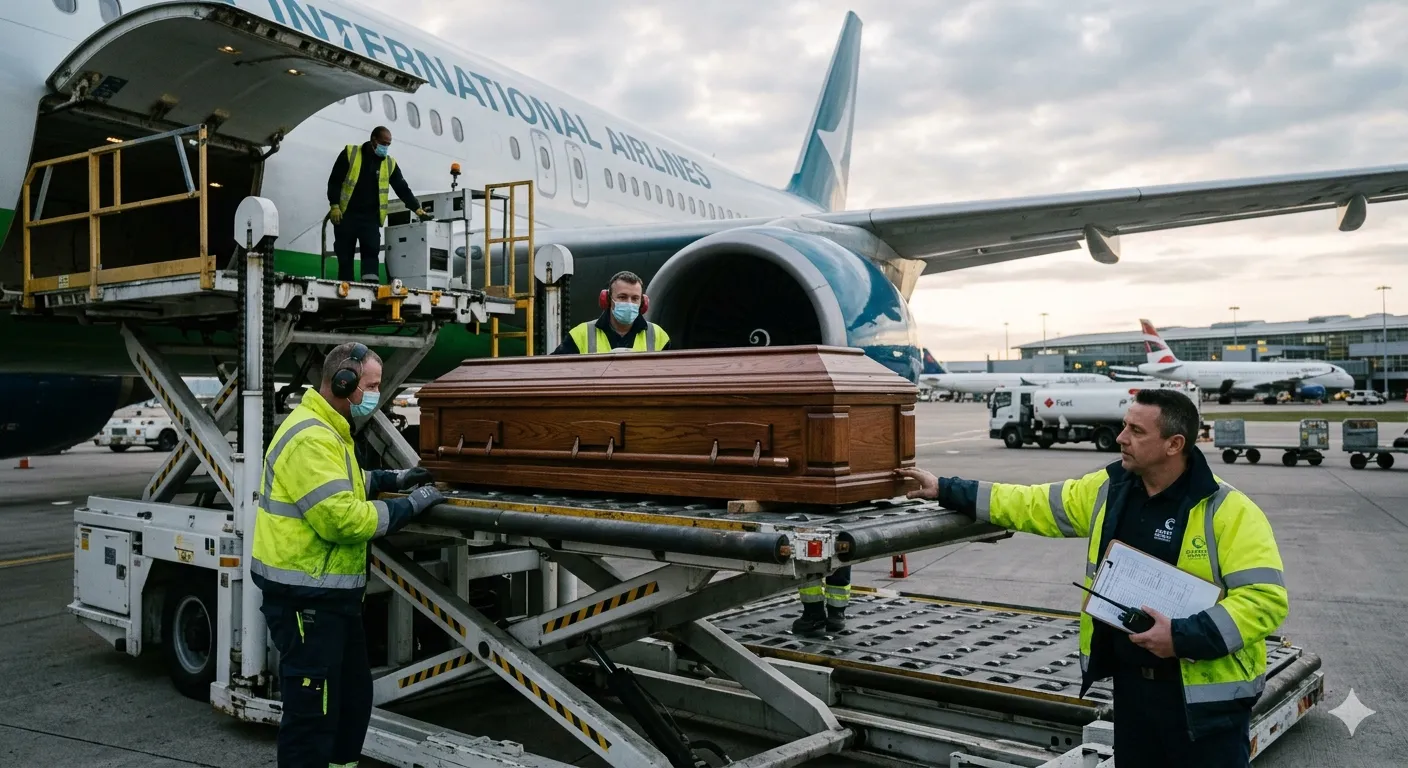
A coffin containing human remains travels as a specialist cargo shipment, not as ordinary luggage. Under the International Air Transport Association’s Compassionate Transportation Manual (CTM), human remains are classified under the code HUM, which triggers a distinct set of handling procedures from acceptance at the cargo terminal through to loading and unloading at the destination.
Airlines are required to treat HUM shipments separately from all other cargo, prohibiting consolidation with non-remains shipments and requiring separation from food or live animals. You can read more about IATA’s standards directly in the IATA Compassionate Transportation Manual. The combined effect of specialist handling, priority allocation, and the sheer weight of a sealed coffin means that air freight for human remains is priced considerably higher than standard cargo. For a UK to Africa route, freight alone can start from around £750 and rise depending on the airline, coffin weight, and route.
2. The Zinc-Lined Coffin Requirement
Standard coffins cannot legally be used for international air transport. IATA regulations require that uncremated remains be placed in a hermetically sealed inner casket, typically achieved through a zinc lining, which is then placed within an outer wooden coffin suitable for air transport. This double-coffin arrangement creates the airtight seal required by aviation and public health standards.
Many countries also require a sealed coffin certificate confirming this standard has been met before customs clearance can proceed at the destination. The zinc lining itself adds meaningful weight to the overall shipment, which in turn increases the air freight calculation. Some providers offer caskets with a built-in sealing system as an alternative, but the cost difference is modest.
3. Embalming and Body Preparation
Embalming is a mandatory step in almost all international repatriations. It is required both by the destination country’s import regulations and by airlines as a condition of accepting the shipment. The embalming process preserves the body for the duration of transit, which in a long-haul repatriation to Africa or Asia can span several days when ground transport and layovers are included.
The procedure must be carried out by a qualified embalmer, and the resulting certificate must accompany the remains throughout the journey. The cost of professional embalming, combined with the preparation and dressing of the body, forms a significant line item in any repatriation invoice.
4. Documentation and Consular Fees
No body can cross an international border without an extensive set of documents. For a standard repatriation from the UK, these include a certified death certificate, an embalming certificate, a non-contagious disease certificate, a coroner’s Out of England certificate, a sealed coffin certificate, and consular approval from the destination country’s embassy in London.
Each of these documents must be obtained from a different authority, often requiring physical visits, notarisation, legalisation, and in some cases translation. The coroner’s notice alone requires a mandatory waiting period before the body can be released for export. Embassy and consular fees, document translation, and notary charges are all added to the service cost as disbursements.
For more complex cases involving unnatural death, an additional postmortem report is required, which further extends the documentation chain and adds cost.
5. Professional Coordination and 24/7 Support
A specialist repatriation provider manages an intricate chain of parties: the coroner, the hospital or mortuary, the embassy of the destination country, the airline cargo division, a local funeral director at the destination, and the family. This coordination work is ongoing across multiple time zones and cannot be interrupted once the process begins.
Professional repatriation services typically charge between $2,000 and $4,000 for complete coordination, covering 24/7 family liaison support, documentation preparation, airline coordination, and customs clearance. Attempting to handle this independently often results in delays and additional costs that exceed what a professional service would have charged.
6. Mortuary Storage and Third-Party Handling
Between the death and the departure flight, the body must be kept in appropriate refrigerated mortuary storage. Depending on how long documentation takes, this can span several days to a few weeks. Storage costs accumulate daily and are passed on as part of the total. Ground transport of the coffin from the mortuary to the airport departure facility, and from the arrival airport to the destination funeral director, also adds to the final figure.
Why Costs Vary So Much Between Destinations
The destination country plays an enormous role in determining the final cost. Countries with simpler import documentation requirements and direct flight routes from the UK will be considerably cheaper than destinations requiring multiple transit stops, complex embassy clearances, or strict additional certifications.
The difficulty of the destination, the length of the journey, and the specific regulatory environment all feed directly into the price. A repatriation to a neighbouring European country, for example, is far simpler and less expensive than one to West Africa or Southeast Asia. Cases involving unnatural death, a coroner’s investigation, or deaths in remote locations without nearby mortuary facilities will also carry additional charges.
Are There Cheaper Alternatives to Full Body Repatriation?
Yes. Several alternatives can reduce the cost substantially, though each involves trade-offs that families must weigh against their cultural, religious, and personal wishes.
Cremation in the UK Followed by Ash Repatriation
The most widely used cost-reduction option is to arrange a cremation in the UK and then repatriate the ashes rather than the body. This removes the most expensive elements from the equation: the zinc-lined coffin, the embalming, and the heavy air cargo charges are all eliminated.
Repatriating ashes avoids the expense of embalming and transporting the body in a zinc-lined coffin, and in some cases the family can carry the ashes as hand luggage on a commercial flight, subject to the airline’s policy and the destination country’s customs rules.
An ashes courier service for international destinations typically costs between £265 for Europe and up to £850 for destinations such as the United States, Canada, or South Africa, making it substantially cheaper than full body repatriation. However, it is important to confirm the receiving country’s regulations, as some nations have specific requirements around the importation of cremated remains.
Local Burial or Funeral in the UK
For families who cannot afford repatriation or who face particularly complex logistics, it is possible to arrange a full funeral and burial in the UK. A local burial or cremation in the country where the death occurred may in some cases have been the wishes of the deceased, and can help reduce the financial burden significantly.
This option is most suitable where the deceased had been living in the UK long-term and had UK-based family, or where the destination country’s regulations make repatriation particularly difficult or expensive.
What You Cannot Compromise On
It is worth being clear about what cannot be reduced, regardless of how costs are managed. Embalming, sealed coffin standards, and documentation requirements are set by international aviation law, individual country regulations, and airline policy. They are not optional extras added by repatriation providers.
The IATA Compassionate Transportation Manual, updated in its sixth edition in 2026, sets mandatory global standards for the packaging, documentation, and handling of human remains. These standards exist to protect airline staff, ground crews, and the dignity of the deceased. Any provider offering repatriation without these elements is not complying with international regulations. You can review the official IATA requirements at iata.org.
Transparent, Compassionate Repatriation with Harmony International
Repatriation is expensive because it is genuinely complex. Every element of the cost, from the zinc-lined coffin to the coroner’s certificate to the airline cargo fee, exists because international law, public health regulation, and aviation safety standards require it. Understanding this helps families make informed decisions rather than being caught off guard.
The most effective way to reduce costs without sacrificing dignity is to explore insurance cover early, consider ashes repatriation where culturally appropriate, and choose a transparent provider who will explain exactly what the cost covers.
Harmony International has been providing professional, compassionate repatriation services since 2013. They handle every step of the process, from coroner and embassy liaison to airline coordination and destination handover, with clear pricing and no hidden charges. Their team is available around the clock, precisely because repatriation cannot wait.
If you need to arrange a repatriation or simply want to understand the process before you need it, contact Harmony International for a no-obligation conversation.
Frequently Asked Questions
Why is repatriation more expensive than a regular funeral?
A regular funeral involves one country’s regulations, one set of providers, and straightforward logistics. Repatriation involves two countries’ legal systems, multiple government agencies, airline cargo regulations, specialist coffin requirements, mandatory embalming, consular authentication, and coordination across time zones. Each of those elements carries a cost, and they cannot be avoided.
Can I arrange repatriation myself to save money?
Technically yes, but in practice it is rarely advisable. Independent attempts to manage the paperwork, coroner liaison, embassy visits, and airline coordination frequently result in delays, errors, and additional costs that exceed what a professional service would have charged. The coroner’s waiting period and embassy processing times alone require experience to navigate efficiently.
Is it always cheaper to repatriate ashes rather than the body?
Yes, in almost all cases. Ash repatriation eliminates embalming, zinc-lined coffin requirements, and heavy cargo charges. However, families must check the specific import regulations of the destination country for cremated remains, as requirements vary. Some countries also have cultural or religious traditions that make cremation an unsuitable option.
Does travel insurance always cover repatriation?
Most annual travel insurance policies include repatriation cover as standard, covering the body or ashes. However, cover limits and conditions vary significantly between policies. Some policies only cover repatriation if death occurs during a trip, not if the person was a long-term resident abroad. Always check the policy wording and contact the insurer before incurring any expenses.
How long does the repatriation process take?
Once the coroner releases the body and all documentation is in order, repatriation from the UK typically takes between 5 and 10 working days. Complex cases involving an inquest, unnatural death, or difficult embassy clearances can take longer. A specialist provider with established relationships with the relevant authorities will be best placed to move efficiently.
Are there any additional charges I should be aware of?
Common additional charges include embassy and notary fees, document translation, upgraded coffin options, mortuary storage beyond any included period, and ground transport at both ends of the journey. A reputable repatriation provider will provide an itemised quotation upfront so that families understand exactly what is and is not included before proceeding.
Pages You Might Like:
UK repatriation services, Destinations We Repatriate, Into the UK, What to do when someone dies, Coffins we offer
 Call us
 Email us