



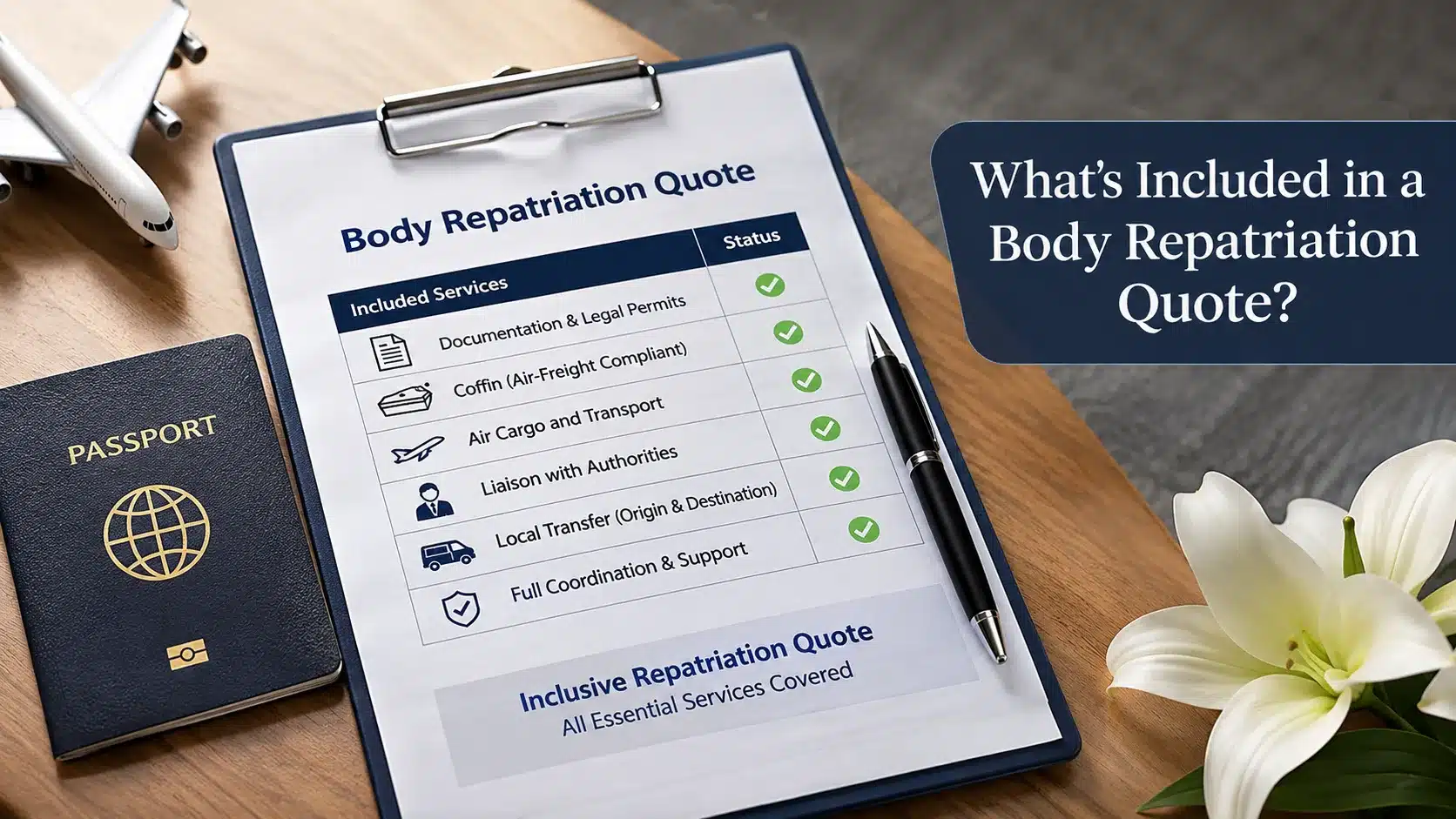
A repatriation quote usually arrives at the worst possible moment. You are grieving, deadlines are tight, and the document in front of you is a list of unfamiliar terms: embalming certificate, zinc-lined inner coffin, consular legalisation, airline handling, disbursements. It is hard to tell whether the total covers everything or is only the start.
This guide explains, line by line, what a proper repatriation quote should include, which items depend on the destination, which costs are often left out and how to compare quotes fairly. It draws on UK government guidance , coroner service procedures, airline and international aviation requirements, and the way specialist providers such as Harmony International structure their service. Use it as a checklist when you read your own quote.
What a Repatriation Quote Actually Covers
A repatriation quote is the combined cost of three things: professional services (care of the deceased, paperwork and coordination), physical items (the coffin and its inner lining) and third party charges (airline freight, consular fees and customs). A clear quote separates these so you can see what you are paying for.
The total changes with the type of repatriation:
- Out of the UK: the person has died in the UK and is being returned to their home country for burial or cremation. The coroner’s authority is needed before the body can leave England and Wales.
- Into the UK: the person has died abroad and is being brought home. Unless they had insurance, the family usually appoints and pays for an international funeral director because the Foreign, Commonwealth & Development Office (FCDO) cannot pay for repatriation.
- Body or ashes: returning cremated remains is a much simpler process with fewer requirements than returning a body, and quotes reflect that.
Two quotes for the same route can differ widely simply because one includes items that the other leaves out. That is why reading the inclusions matters more than comparing the headline price.
The Core Inclusions, Line by Line
The line items below appear in most full body repatriations. Even the United Nations Development Programme’s list of reimbursable repatriation expenses follows the same pattern: airfreight, casketing, embalming, zinc liner sealing, consular fees, clearance at both airports and translation of documents. Use these headings to check your own quote.
- Collection and care. Transfer of the deceased from the hospital, mortuary or home into professional care, plus storage until departure. Ask how many days of storage are included.
- Embalming and preparation. Many airlines and destination countries require embalming, and an embalming certificate must usually accompany the remains. Preparation is done to international transport standards.
- Coffin and sealed inner lining. International aviation guidance says remains must be packed in a hermetically sealed inner container, which may be a rigid lead or zinc coffin, placed inside a wooden or metal outer coffin. Harmony publishes its own coffin requirements for families who need the detail.
- Ground transport. Hearse or transfer vehicle to the airport, and from the arrival airport to the receiving funeral home.
- Airfreight. Human remains travel as cargo under a special handling code, and not all airlines or airports can accept them. Your quote should name the route and whether the flight is direct or has a connection.
- Airport and customs handling. Export clearance at departure and import clearance on arrival, handled by the airline cargo departments and customs.
- Documentation and legal support. Death certificates, coroner authority, consular papers and translations, covered in the next section.
- Receiving agent at destination. A local partner who meets the flight, completes import formalities and hands the deceased to the family or funeral director.
- Optional farewell before departure. Some providers can arrange a service in the UK first.
- Coordination and updates. A single point of contact, ideally 24 hours a day, who keeps you informed of flight times and progress.
Documentation and Legal Paperwork
Paperwork is where many repatriations are delayed, so a good quote states exactly who handles it. Harmony lists the documents it manages on its documentation page. The government sources below show what the law requires.
Leaving England and Wales. Anyone moving a body out of England and Wales, including to Scotland, needs authority from a coroner, even when the death was natural. Your funeral director sends the coroner a notice of intention to remove the body, known as Form 104, with a copy of the death certificate unless there is an ongoing investigation. Typical supporting items include:
- The completed application questionnaire
- A doctor’s identification certificate
- The passports of the deceased and of the person applying
- The death certificate from the registrar
If approved, the coroner issues Form 103 to the funeral director. Coroner services advise that you should not book flights until it is signed. The notice period is commonly four clear days, though some coroner areas state different timings, so ask your provider to confirm. Cremated remains do not need coroner authority.
Arriving in the UK. When someone dies abroad, the FCDO explains that the local death certificate can normally be used in the UK, with an official translation if needed, and that a post mortem may take place in the UK even if one was done abroad. The registrar for the area of the funeral must be told, and a cremation also needs Home Office permission, according to Citizens Advice.
Airline and destination papers. Airlines typically require an embalming certificate and original documents travelling with the remains. Many consulates also ask for their own mortuary certificate, sometimes with translated or legalised documents.
What Drives the Price Up or Down
No two repatriations cost the same, and that is not a sign of unfair pricing. These are the main variables:
- Destination and routing. Distance, the availability of direct flights and the airline’s freight rates all shift the total.
- Weight and airline. Freight is charged by weight and varies between carriers and routes.
- Coffin specification. The destination country and airline decide the type of coffin and inner lining required.
- Coroner involvement. If the death is being investigated or a post mortem is needed, the timeline stretches and storage and handling costs can rise.
- Timing and urgency. Religious requirements for a quick burial, weekends, bank holidays and flight availability affect both cost and speed.
- Documentation complexity. Translations, legalisation and consular fees depend on the country.
- Storage time. Extra days in the mortuary add up if paperwork or flights are delayed.
- Funeral service before departure. A farewell ceremony in the UK is a separate service and adds to the total.
- Remains or ashes. Cremated remains avoid several of the most expensive items, such as the sealed coffin and cargo handling of a body.
When you receive a quote, ask which of these have been assumed. A low price built on an assumption that does not hold will not stay low.
Common Exclusions and Extras to Watch For
The most frustrating surprises come from items a quote does not mention. Check whether the following are included, estimated or excluded:
- Funeral costs at the destination. Burial or cremation, a local funeral director, the grave or cremation fee and any ceremony usually sit outside the repatriation price.
- Variable third party charges. One UK funeral provider’s repatriation booklet explains that disbursements and third party fees, such as airline charges, are added to professional fees and should appear in a detailed quote.
- Post mortem and coroner related costs. Check who pays if one is required.
- Additional certified copies and translations. Needed more often than families expect.
- Extra storage or re-routing. Flight cancellations or documentation delays can add days and costs.
- Family travel. Flights, visas and accommodation for relatives travelling with the deceased are almost never included.
- Flowers, notices and memorial items.
Check your insurance and benefits. The FCDO cannot pay for repatriation, but travel insurance may cover it, and Citizens Advice advises families to discuss costs before confirming arrangements. In some cases a Funeral Expenses Payment is available for deaths abroad, according to GOV.UK. Share your insurer’s requirements with your provider early, since many insurers need to approve costs before work begins.
How to Compare Quotes Fairly
Comparing totals alone is risky. Compare what each quote includes, using this checklist:
- Is the quote itemised, with professional fees, coffin, freight and third party charges shown separately?
- Is each figure fixed, or an estimate that may change?
- Does it name the destination airport, airline or route?
- Does it say who handles the coroner paperwork, embalming certificate and consular documents?
- Does the coffin and inner lining meet both the airline and the destination country’s rules?
- How many days of mortuary storage are included, and what is the daily rate after that?
- Is the receiving agent at the destination included?
- What happens to the cost if a flight is delayed or re-routed?
- Is there a named contact available 24 hours a day?
- What are the payment terms, and will the provider deal directly with your insurer?
It also helps to understand who you are hiring. A local funeral director and an international repatriation specialist do different jobs, and the second usually has the airline, consular and overseas partner relationships that make timelines predictable. Some families ask whether they can arrange repatriation themselves. Because of the coroner, airline and consular steps above, it is rarely practical without professional help.
To see a real itemised quote for a specific country, you can request one from Harmony International.
Clarity Is the Real Value of a Good Quote
A good repatriation quote does more than give a price. It tells you what is being done for your loved one, who is responsible for each step and where costs could change. Look for itemised care and preparation, a compliant coffin, clear documentation responsibilities, named airline and handling arrangements, and a single contact who keeps you informed.
If you are facing a repatriation now, Harmony International can help. Their UK-based team is available 24 hours a day, manages the paperwork, embassy and coroner liaison, embalming, coffin, flights and customs, and provides a clear quote before work begins. Call them on (+44) 2030 264 464 or request a free quote for your destination.
Learn more at harmony-international.co.uk.
Frequently Asked Questions
Does a repatriation quote include the funeral at the destination?
Usually not. Most quotes cover the journey: care, preparation, coffin, paperwork, flight and handover. Burial or cremation costs and ceremonies in the destination country are normally arranged and paid for separately.
Why does the quote say “estimated”?
Airline freight, consular fees and third party charges can change before travel. A detailed quote should show which lines are fixed and which are estimates.
How long does repatriation take?
It depends on the destination, coroner involvement and flight availability. Harmony’s FAQs describe a range from a few days to a couple of weeks. A coroner investigation or post mortem will lengthen it.
Do I need the coroner’s permission to send a body abroad from the UK?
Yes, for a body leaving England and Wales, even if the death was natural. Your funeral director submits Form 104 and waits for the coroner’s signed authority before flights are booked. Cremated remains do not need coroner authority.
Why is embalming usually part of the quote?
Many airlines and destination countries require it, and an embalming certificate usually travels with the remains. Your provider will confirm the rule for your route.
Can travel insurance pay for repatriation?
Often, yes. Check the policy wording and contact the insurer early. The FCDO cannot pay for repatriation but can advise and help with transferring money from family in the UK.
Is repatriating ashes cheaper than repatriating a body?
Generally yes, because it avoids the sealed coffin, embalming and cargo handling of a body, and the paperwork is lighter. Some countries still have their own rules for importing ashes, so check before you travel.
What should I do first?
Tell your provider as early as possible, gather the death certificate and passports, and ask for an itemised quote. Early contact gives the coroner, embassy and airline processes the longest possible head start.
Sources
- GOV.UK: What to do after a British national dies abroad
- Central Bedfordshire Council Coroner Service: Repatriation of deceased, moving a body out of England and Wales
- Hertfordshire County Council: Taking a body out of England
- Worcestershire County Council: Form 104, notice to a coroner of intention to remove a body out of England
- Citizens Advice: What to do if someone dies abroad
- UNDP: List of reimbursable expenses, repatriation of mortal remains
- ICAO: Standards related to the repatriation of human remains
- Emirates SkyCargo: Transport of human remains
- Air Cargo Week: The final journey, moving human remains by airfreight
- Funeral Partners: International repatriation booklet
- Harmony International: Homepage
- Harmony International: How it works
- Harmony International: Documentation
- Harmony International: Coffin requirements
- Harmony International: Destinations and prices
 Call us

 Email us