



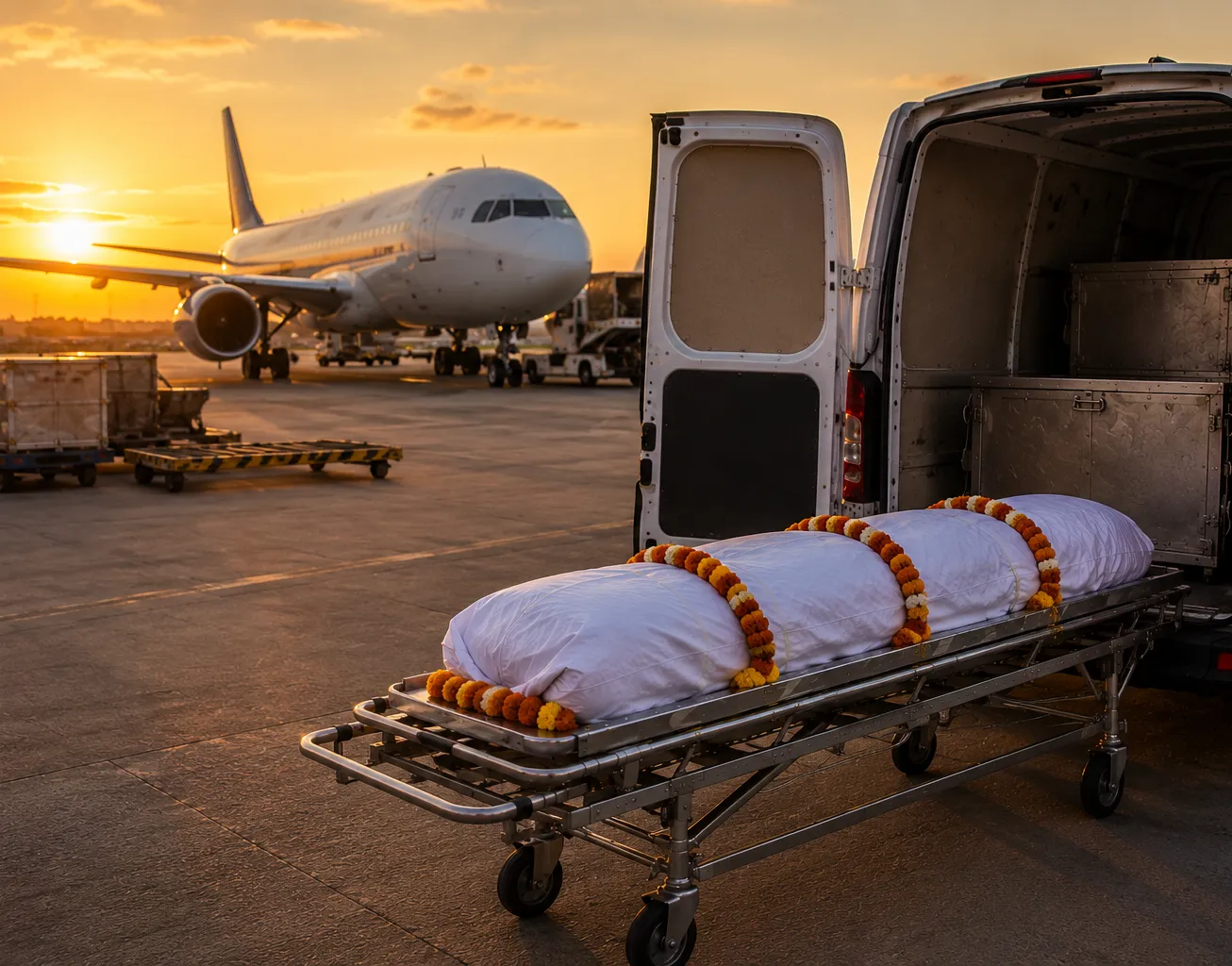
For Hindu families living in the United Kingdom, the death of a loved one carries a weight that is both personal and deeply spiritual. Hindu tradition prescribes a precise sequence of sacred rites, beginning within hours of death and continuing for thirteen days or more, each designed to support the soul’s passage toward moksha, or liberation from the cycle of birth and rebirth.
When a Hindu person dies in the UK and the family wishes to repatriate the body to India, Sri Lanka, Nepal, or another home country, they face a challenge unique to diaspora life: honouring an ancient spiritual tradition within a modern legal and logistical framework that was never designed with those traditions in mind.
This guide covers both dimensions. It explains the Hindu rites that form the heart of the repatriation process, and it sets out the legal and documentation requirements that govern how a body may be transported from the UK across an international border.
Why Repatriation Matters for Hindu Families
Hinduism does not merely prefer cremation. For the vast majority of Hindus, cremation on Indian soil, performed according to the Antyesti Sanskar, and followed by the immersion of ashes in a sacred river such as the Ganges, is considered the spiritually correct conclusion to a human life.
Antyeshti rites are the final sacraments in a series of samskaras that ideally begin at the moment of conception. The ashes are traditionally disposed of in a sacred river, completing the return of the five elements that compose the body back to the cosmos.
For many families, performing these rites on UK soil alone, without the presence of extended family, a Hindu priest versed in their regional tradition, or access to sacred water, feels spiritually incomplete. Repatriation is therefore not simply a logistical preference. It is, for many, a religious obligation.
The Hindu Rituals: What Happens After Death
Understanding the spiritual timeline helps families and repatriation providers work together effectively. The Antyesti Sanskar, also called Antim Sanskar, is the sixteenth and final samskara in the Hindu life cycle, and it encompasses a sequence of rites that begin the moment a person dies.
Immediately After Death
Traditionally, the body is placed on the floor with the head pointing south, the direction associated with Yama, the god of death. An oil lamp, or diya, is lit near the body and kept burning continuously for the first three days. The Garuda Purana, a sacred text that describes the soul’s journey after death, is traditionally read aloud in the home during this period.
The family enters a period known as Sutak or Ashaucha, a state of ritual impurity during which they observe a simple diet, abstain from temple visits, and focus entirely on the rites for the deceased. The Garuda Purana prescribes specific durations of Sutak by community: ten days for Brahmins, twelve for Kshatriyas, fifteen for Vaishyas, and one month for Shudras.
Preparation of the Body
The body is bathed in water mixed with sesame seeds and Ganga jal (water from the Ganges) in a ritual called Mritsnan, which purifies the gross body before its return to the five elements. It is then dressed in new white cloth, with no stitched clothing, and turmeric is applied to the forehead while sandalwood paste is applied to the throat and chest. The body is laid on a bier of bamboo poles bound with white cloth. Marigolds and other flowers are arranged around the body, and offerings of rice, sesame seeds, and incense are placed nearby.
Mukhagni: The Lighting of the Pyre
At the cremation ground, the eldest son, or the designated chief mourner, performs the Mukhagni, the act of lighting the funeral pyre. A Hindu priest guides the family through prayers and the pouring of ghee and other sacred offerings into the fire. The word Antyesti translates from Sanskrit as the final sacrifice, from antya (last) and ishti (sacrificial rite). The eldest son traditionally lights the pyre, but classical texts including the Dharmasindhu explicitly permit daughters and other relatives when no male heir is present.
Asthi Visarjan: The Immersion of Ashes
After the cremation, the ashes, referred to as Asthi, are collected, traditionally on the third day. They are then immersed in a sacred river, most ideally the Ganga, in a ceremony called Asthi Visarjan. This act symbolises the final release of the soul and the merging of the five elements back into nature. The immersion is typically carried out in Haridwar, Varanasi,The day after a Hindu funeral, the ashes are scattered over a sacred body of water or a place of importance to the deceased.
Post-Cremation Rites: Days 1 to 13
The period following cremation is marked by further rites designed to aid the soul’s transition. Pind Daan, the offering of rice balls, and Tarpan, the offering of water, are performed to nourish and appease ancestral spirits. The thirteenth-day ritual, known as Tehravin, marks the end of the formal mourning period. The Shraddha ceremony, performed on specific anniversaries of the death, continues to honour the deceased in the years that follow.
How Repatriation Affects the Ritual Timeline
Hindu tradition calls for cremation to take place as swiftly as possible after death, ideally within 24 hours. This is grounded in the belief that the soul’s transition is best supported when the body is returned to the elements without delay.
The UK legal process, however, requires time. A death must be registered with the local Register Office, typically within five days. If the death was sudden, unnatural, or occurred without a doctor present, the coroner must be involved, which can extend the timeline by several days. A coroner’s Out of England certificate must be issued before the body can be transported abroad, and this carries its own waiting period.
This tension between the spiritual imperative of speed and the legal requirement for documentation is one of the defining challenges of Hindu repatriation from the UK. An experienced repatriation provider will understand this tension and will move through the documentation process as efficiently as possible, always keeping the family informed so they can manage the spiritual preparations in parallel.
The Legal Requirements for Hindu Repatriation from the UK
Regardless of the destination country, every repatriation from England and Wales must satisfy the following legal requirements. A specialist provider will manage these on the family’s behalf.
1. Register the Death in the UK
The death must be registered at the local Register Office, producing the official UK death certificate. This is the foundational document for all subsequent steps. If the coroner is involved, an interim certificate may be issued to allow the process to begin while the investigation continues.
2. Notify the Coroner
Before a body can be removed from England or Wales, the coroner must receive a ‘Form of Notice to a Coroner of Intention to Remove a Body out of England or Wales’. The coroner must be given at least four clear days’ notice before the body can be released for export. In Scotland, the equivalent document is a Furth of Scotland letter issued by the Procurator Fiscal. Full details of the coroner’s role are available on GOV.UK.
3. Obtain Consular Clearance from the Destination Country
For repatriation to India, a No Objection Certificate (NOC) must be obtained from the Indian High Commission in London. This document confirms that the Indian authorities have no objection to the repatriation and is required by airlines and Indian airport authorities before the shipment can be accepted. For repatriation to India specifically, the Indian High Commission website provides current consular requirements and fee structures. For Nepal, Sri Lanka, or other destinations, the equivalent embassy must be contacted.
4. Embalming
Embalming is a mandatory requirement for international air transport of human remains. It is required by airlines and by the customs authorities of most destination countries. This presents a genuine tension for Hindu families: traditional Hindu custom generally considers the body to be in a state of ritual purity and discourages intervention beyond the ritual bathing described above.
Hindu tradition generally avoids embalming, since the tradition favours cremation and prompt funeral arrangements. However, for international repatriation, it is a legal and airline requirement that cannot be waived. Families should discuss this with their repatriation provider so that the process is carried out with as much sensitivity and care as possible, and so that any post-embalming ritual bathing that the family wishes to perform can be accommodated where practicable.
5. The Zinc-Lined Coffin
International air transport regulations set by the International Air Transport Association (IATA) require that the remains be placed in a hermetically sealed coffin, typically a zinc-lined inner coffin within an outer wooden coffin. A sealed coffin certificate must accompany the shipment.
For Hindu families who intend to cremate the body on arrival, the coffin is a transit requirement only. It is entirely removed and the body transferred for cremation by the receiving funeral director at the destination. Families should confirm this arrangement in advance with both the UK repatriation provider and the funeral home at the destination.
6. Full Documentation Checklist
The complete set of documents typically required for a Hindu repatriation from the UK to India includes:
- Certified UK death certificate
- Coroner’s Out of England certificate
- Embalming certificate
- Freedom from Infection certificate / Non-Contagious Disease certificate
- Sealed coffin certificate
- No Objection Certificate (NOC) from the Indian High Commission in London
- Original passport of the deceased
- Postmortem report, if the death was unnatural or the coroner investigated
- Letter of authority signed by the next of kin authorising the repatriation provider to act on behalf of the family
What Happens on Arrival in India
On arrival at the destination airport, the coffin undergoes customs clearance. Indian airport authorities will verify the documentation, including the NOC from the Indian High Commission in London and the sealed coffin certificate. A local funeral director or receiving representative coordinates the transfer from the airport. The UK repatriation provider should have an established relationship with a local partner at the destination to ensure continuity. Once the body is received by the local funeral director, the coffin is removed and the body is prepared for the Antyesti Sanskar according to the family’s tradition. The Asthi Visarjan can then take place at the family’s chosen sacred site. Detailed guidance on the receiving process in India can be found through the Indian High Commission London.
An Alternative: Ash Repatriation
A growing number of Hindu families in the UK choose to perform the cremation in the UK and then repatriate only the ashes to India for the Asthi Visarjan. This approach eliminates the most complex and costly elements of full body repatriation: the zinc-lined coffin, the mandatory embalming, and the heavy air cargo charges.
In many cases, the ashes can be carried as hand luggage on a commercial flight, subject to the airline’s policy and Indian customs requirements. The family would need to carry the death certificate and cremation certificate, and the ashes should be in a secure, sealed container.
For families where the primary spiritual concern is the immersion of the ashes in the Ganga, ash repatriation may be a fully appropriate and significantly more affordable alternative. It is worth discussing with a Hindu priest whether this approach satisfies the family’s specific tradition and obligations.
Compassionate Hindu Repatriation with Harmony International
Arranging the repatriation of a Hindu loved one from the UK is one of the most logistically and emotionally demanding tasks a family can face. The need to honour sacred rites within a tight spiritual timeline, while simultaneously navigating coroner’s procedures, embassy clearances, and airline regulations, requires expert support and genuine cultural understanding.
Harmony International has been providing professional, compassionate repatriation services since 2013. Their team understands the importance of speed in Hindu tradition, the sensitivities around embalming, and the logistical requirements of coordinating with Indian airport authorities, the High Commission in London, and local funeral directors at the destination.
Whether you need to arrange full body repatriation for the Antyesti Sanskar in India, or are considering ash repatriation for the Asthi Visarjan, Harmony International can guide your family through every step with clarity, respect, and round-the-clock availability.
Contact Harmony International today for a compassionate, no-obligation conversation.
Frequently Asked Questions
- Can a Hindu cremation take place in the UK before repatriation?
Yes. Many Hindu families choose to perform a cremation in the UK and then repatriate the ashes. A Hindu priest can lead the Mukhagni and other rites at a UK crematorium, and the ashes can then be taken to India for the Asthi Visarjan in the Ganga or another sacred river. This significantly reduces the cost and complexity compared to full body repatriation.
- Is embalming required even though it conflicts with Hindu custom?
For international air repatriation of a body, embalming is a legal and airline requirement that applies regardless of the religious tradition of the deceased. Families should communicate their concerns clearly to the repatriation provider, who can ensure the process is carried out with appropriate sensitivity. Where ash repatriation is chosen instead, embalming is not required.
- How long does repatriation from the UK to India usually take?
After the coroner has issued clearance and the required paperwork has been completed, transporting a deceased person from the UK to India generally takes around 5 to 10 working days. The timeline may extend if there is an ongoing coroner’s inquiry, an unexpected or suspicious death, or delays related to embassy approvals and official documentation. Starting the arrangements soon after the death is registered can help avoid unnecessary delays.
- Is the body transported in a coffin suitable for Hindu customs?
For international air transport, airlines require the body to be placed in a sealed coffin that complies with IATA regulations, usually including a zinc-lined interior. This packaging is only for transportation purposes. Once the body reaches India, the receiving funeral provider can transfer the deceased from the transit coffin and prepare them according to Hindu funeral traditions and Antyesti Sanskar rites. Families may also request that no additional procedures or preparations are carried out before arrival.
- Which documents does the Indian High Commission in London require?
The Indian High Commission requires the death certificate, the UK coroner’s Out of England certificate, embalming and sealed coffin certificates, and the deceased’s passport before issuing the No Objection Certificate. Requirements can be confirmed directly through the consular services section of the Indian High Commission website. Your repatriation provider will manage the submission and collection of these documents.
- Can the family accompany the body on the same flight?
Yes. Once the airline issues its clearance for the cargo shipment, the repatriation provider can advise the family of the flight details so they can book their own passenger tickets on the same service if they wish. This allows the family to accompany their loved one on the final journey home.
- What happens to the body if the coroner orders a postmortem?
If the coroner orders a postmortem, the body cannot be released until the investigation is complete. An interim death certificate is usually issued to allow the repatriation process to begin in parallel. The coroner’s Out of England certificate is then issued once the investigation concludes. This can add several days to the overall timeline, and the repatriation provider should update the family at each stage.
Pages You Might Like:
UK repatriation services, Destinations We Repatriate, Into the UK, What to do when someone dies, Coffins we offer
 Call us
 Email us