



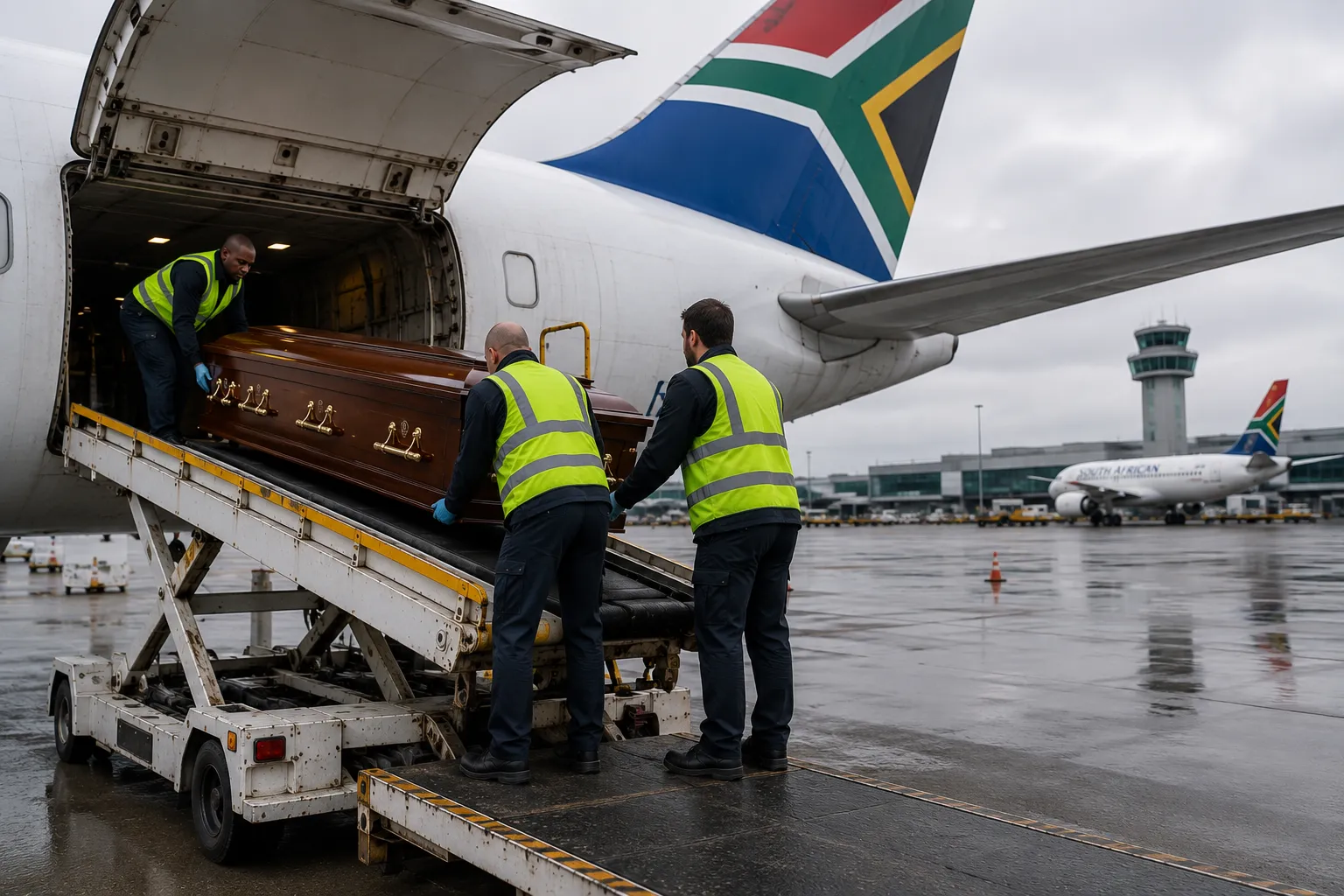
When a South African national or a member of the South African community passes away in the United Kingdom, the family’s most immediate concern is often bringing their loved one home. This process, known as repatriation, involves a carefully coordinated series of legal, administrative, and logistical steps that must be completed before human remains can be transported internationally.
South Africa is one of the most frequently requested destinations for repatriation from the UK, and the process involves specific requirements set by both British authorities and the South African consulate. This guide sets out every step of the process in plain terms so that families can approach it with clarity and confidence.
Step 1: Register the Death in the UK
The first step following any death in the UK is formal registration. In England and Wales, deaths must be registered within five days at the local register office. The General Register Office (GOV.UK) provides full guidance on where and how to do this depending on the region.
Once registered, the family receives the official UK death certificate. This document is central to the entire repatriation process and will be required at multiple stages, including when applying for consular clearance and when completing airline freight documentation.
If the death was sudden, unexplained, or occurred in circumstances that require further investigation, the Coroner will be notified. In such cases, the Coroner must complete their inquiries and issue an Out of England Order before the body can legally leave the country. A professional repatriation provider should liaise with the Coroner’s office directly and keep the family updated on timelines.
Step 2: Notify the South African High Commission
The South African High Commission in London plays a central role in the repatriation process. Families or their appointed repatriation provider must contact the High Commission to begin the consular clearance procedure. The High Commission will require a range of documents (detailed in Step 4 below) and will issue the necessary authorisation for the remains to enter South Africa.
It is important to begin contact with the High Commission early in the process, as consular processing times can vary. An experienced repatriation company will have established relationships with consular staff and understand exactly what is required to avoid unnecessary delays.
Step 3: Arrange Embalming
Embalming is a legal requirement for the international air transport of human remains. The process preserves the body to ensure it can be safely and respectfully transported over long distances and across international borders.
Embalming must be carried out by a licensed professional. Once completed, an embalming certificate is issued. This certificate forms a mandatory part of the documentation package submitted to the South African High Commission and the airline. The embalming must take place before the body is placed in a hermetically sealed coffin approved for air freight.
Step 4: Prepare the Required Documentation
The documentation stage requires thorough coordination between multiple parties. For repatriation from the UK to South Africa, the following documents are typically required:
- Original UK death certificate
- Out of England Order from the Coroner, where applicable
- Valid passport of the deceased
- Embalming certificate signed by a licensed embalmer
- Certificate of sealing, confirming the coffin has been hermetically sealed
- Clearance or no-objection letter from the South African High Commission in London
- Airway bill issued by the freight carrier
- Letter from the funeral director confirming the identity of the deceased
A reputable repatriation specialist will manage the preparation, verification, and submission of all documentation on the family’s behalf, significantly reducing the risk of errors or omissions that could delay the process.
Step 5: Select the Appropriate Coffin
International air freight regulations require that human remains be transported in a hermetically sealed coffin, typically zinc-lined, that meets the standards required for air cargo. The coffin must be structurally sound and fully sealed to comply with both UK export requirements and South African import requirements.
Families can usually choose an outer coffin that reflects the cultural, religious, or personal preferences of the deceased. South African communities in the UK often have specific traditions around burial and ceremony, and a sensitive repatriation provider will do their best to accommodate these within the regulatory framework.
Step 6: Book the Airfreight
Human remains are transported as regulated cargo aboard commercial flights. The repatriation provider books the airfreight directly with a carrier that operates routes from the UK to South Africa. Major destination airports include OR Tambo International Airport in Johannesburg, Cape Town International Airport, and King Shaka International Airport in Durban. Arrangements can often also be made for onward transport to Pretoria, Port Elizabeth, and other locations through trusted local partners.
All airfreight must comply with IATA (International Air Transport Association) regulations governing the carriage of human remains, as well as standards set by the Civil Aviation Authority (CAA). Flight costs from London to South Africa typically begin from around £750, though this varies depending on routing, weight, and availability at the time of booking.
Step 7: Transport the Coffin to the UK Departure Airport
Once all documentation is in order and the airfreight is booked, the repatriation provider arranges transport of the coffin from the mortuary or funeral home to the departure airport. This is typically Heathrow or Gatwick, depending on which carriers operate the freight service.
The coffin is delivered to the airline’s cargo facility, where it is processed for loading. The repatriation provider will handle all formalities at this stage, including the submission of the airway bill and accompanying documentation.
Step 8: Customs Clearance on Arrival in South Africa
On arrival at the receiving airport in South Africa, the remains must pass through customs. The full documentation package must be presented to South African customs officials. This is usually managed by the receiving funeral director in South Africa or by a nominated family representative.
South Africa’s Department of Home Affairs manages the registration of deaths of foreign nationals and returning citizens. Families can find relevant guidance through the South African Department of Home Affairs. It is advisable to have a trusted local funeral director in South Africa confirmed and briefed well before the remains arrive, so that onward transport and funeral arrangements can proceed without delay.
How Long Does Repatriation from the UK to South Africa Take?
In straightforward cases where the death is registered promptly, no Coroner’s involvement is required, and all documentation is complete, repatriation from the UK to South Africa can typically be completed within five to ten working days. Where a Coroner’s investigation is underway, or where documentation is incomplete, the process may take considerably longer.
Working with a specialist repatriation provider helps to minimise delays by ensuring that all steps are completed in the correct order and that no required documents are overlooked.
What Does Repatriation from the UK to South Africa Cost?
The total cost of repatriation is made up of the specialist service fee, the airfreight charge, and any relevant third-party costs such as Coroner fees, High Commission fees, or charges associated with the receiving funeral director in South Africa.
A standard repatriation service from the UK to South Africa begins from approximately £1,750 plus flight costs, with flights typically starting from around £750 from London. Families should always request a full, itemised quotation before committing to a provider.
If the deceased held travel insurance, the policy may cover some or all repatriation costs. Notify the insurer as early as possible and obtain written confirmation of coverage before incurring expenditure.
Why Use a Professional Repatriation Service?
Repatriation involves multiple government authorities, tight regulatory requirements, and coordination across international borders. Managing this independently is technically possible but is rarely practical for a grieving family. A single documentation error can cause delays of days or even weeks.
A professional repatriation company acts as a single point of contact, managing all aspects of the process including liaison with hospitals, Coroners, the South African High Commission, airlines, and local partners in South Africa. This allows families to focus on their grief and on supporting one another, rather than on administrative coordination.
Harmony International has been supporting families across the UK with international repatriations since 2013. Their team has extensive experience with South Africa repatriations, maintaining relationships with South African consular authorities, airlines, and trusted local partners across Johannesburg, Cape Town, Durban, and beyond. The team is available 24 hours a day, seven days a week.
Frequently Asked Questions
Can Harmony International arrange repatriation to cities outside Johannesburg and Cape Town?
Yes. While OR Tambo in Johannesburg and Cape Town International are the primary receiving airports, Harmony International can arrange onward transport to Durban, Pretoria, Port Elizabeth, and other locations through their network of trusted local partners across South Africa.
What happens if the Coroner is involved?
If the death is subject to a Coroner’s investigation, the remains cannot leave the UK until the Coroner issues an Out of England Order. The timeline depends on the nature and complexity of the investigation. Harmony International liaises directly with the Coroner’s office to monitor progress and move quickly once clearance is granted.
Is embalming always required for repatriation to South Africa?
Yes. Embalming is a standard requirement for the international air transport of human remains. It is required by both airline freight regulations and South African import requirements. The embalming certificate is a mandatory document in the consular clearance process.
Can the deceased be dressed or have personal items included?
In most cases, yes. The deceased can be dressed and personal items can be placed inside the coffin, subject to airline and customs regulations. Your repatriation provider will advise on what is and is not permitted based on current requirements.
How do I know which airport in South Africa will receive the remains?
This depends on the final destination within South Africa and the available freight routes at the time of booking. Harmony International will discuss this with the family and advise on the most practical routing based on where the burial or funeral service will take place.
Will Harmony International communicate with the South African High Commission on my behalf?
Yes. Liaison with the South African High Commission in London is a standard part of the repatriation service. Harmony International handles all consular communication, document submission, and follow-up to obtain the required clearances.
Can travel insurance help cover the cost?
Many travel and life insurance policies include a repatriation benefit. Contact the insurer as early as possible after the death, provide them with the death certificate, and obtain written confirmation of what is covered. Harmony International can support families in navigating the claims process.
Start the Process with Support That Understands
Repatriation from UK to South Africa is one of the most significant acts of care a family can undertake. The process carries real weight, both practically and emotionally, and having the right support in place makes an immeasurable difference.
Harmony International has been trusted by South African families across the UK since 2013. From the first phone call to the final handover, their experienced team manages every detail with professionalism, sensitivity, and round-the-clock availability.
Contact Harmony International to begin.
Pages You Might Like:
UK repatriation services, Destinations We Repatriate, Into the UK, What to do when someone dies, Coffins we offer
 Call us
 Email us