



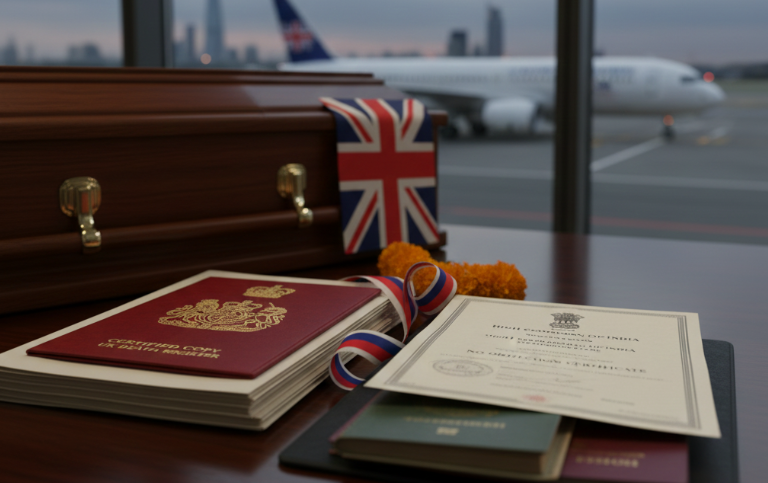
Repatriating a loved one is a sensitive process that involves legal, medical and logistical responsibilities. When the journey is from the United Kingdom to India, both countries require specific paperwork and formal procedures. Understanding how these steps work can help families handle the situation with clarity during a very difficult time.
1. Begin With the Formal Death Registration
Once a doctor or coroner confirms the cause of death, you will receive a medical certificate. The death must then be registered with the local registry office. The process is guided by the requirements set out on the official site of GOV.UK, which explains how registrations must usually take place within five days and how certified copies of the death certificate can be requested.
Multiple copies of the certificate are useful because airlines, consulates and airport authorities may need them for processing.
2. Seek Support From an International Repatriation Specialist
Repatriation specialists coordinate all transport arrangements between both countries. They communicate with coroners, consulates, funeral directors and airlines while managing documentation on behalf of the family.
This reduces the possibility of delays and ensures that all procedures meet the standards outlined by the Foreign, Commonwealth & Development Office for returning a body overseas.
A specialist also ensures that every form, certificate and airline requirement meets the criteria set by Indian authorities before the remains are accepted for entry into the country.
3. Secure the Required Documents for UK and Indian Authorities
Repatriation from the UK to India cannot proceed until all essential documents have been obtained. These are normally coordinated by the appointed repatriation provider. Typical requirements include:
- Death certificate issued in the UK
- Passport of the deceased
- No Objection Certificate from the coroner
- Embalming certificate
- Certificate of freedom from infection
- Coffin sealing certificate
- Flight documentation
- Consular paperwork for India
Most of these documents are part of the process described by the Foreign, Commonwealth & Development Office for transporting human remains abroad.
For Indian entry requirements and consular permissions, families follow guidance issued by the High Commission of India in London. Their published instructions outline what is needed for clearance at Indian airports and what documents must accompany the remains on arrival.
4. Complete the Preparation of the Remains
Airlines and airport health officials require the remains to be prepared according to international aviation and public health regulations. This stage involves embalming by a licensed professional, selecting an approved coffin and sealing it correctly.
The preparation process follows general standards recognised by UK coroners and international carriers, and also aligns with the medical entry requirements for India published by the High Commission of India in London. A repatriation specialist monitors these steps so that the remains meet all conditions set by both countries.
5. Arrange the Flight From the UK to India
Flights typically depart from airports such as Heathrow, Gatwick or Manchester. Humanitarian transport bookings need airline approval and must follow rules for handling human remains. Families receive departure details once all documents have passed UK checks and the Indian consular office has confirmed acceptance.
Airline clearance often depends on the accuracy of the documentation referenced earlier in the guidance issued by the Foreign, Commonwealth & Development Office.
6. Final Procedures After Arrival in India
When the flight lands, airport authorities in India carry out checks before releasing the remains. The process involves inspection by medical officers, customs verification and confirmation of the consular paperwork. These requirements are consistent with the procedures described by the High Commission of India in London.
Once clearance is complete, the remains are handed to the receiving family or a funeral director arranged in advance.
7. Understanding the Costs
Repatriation costs vary based on the collection location in the UK, airline availability, documentation charges and coffin preparation. Repatriation providers normally supply a clear and itemised cost breakdown so that families can make informed decisions without unexpected additions.
If You Need Reliable Support, Harmony International Can Assist You
Organising repatriation from the UK to India can feel overwhelming, especially during a time of loss. Harmony International offers complete repatriation support that covers documentation, preparation, flight coordination and liaison with authorities in both countries. Our team is available to guide you through every stage with careful attention to detail.
Reach out to Harmony International for dependable assistance and thoughtful support whenever you need help with repatriation arrangements.
Read more in our Guide to International Repatriation Services.
Pages You Might Like:
 Call us
 Email us