



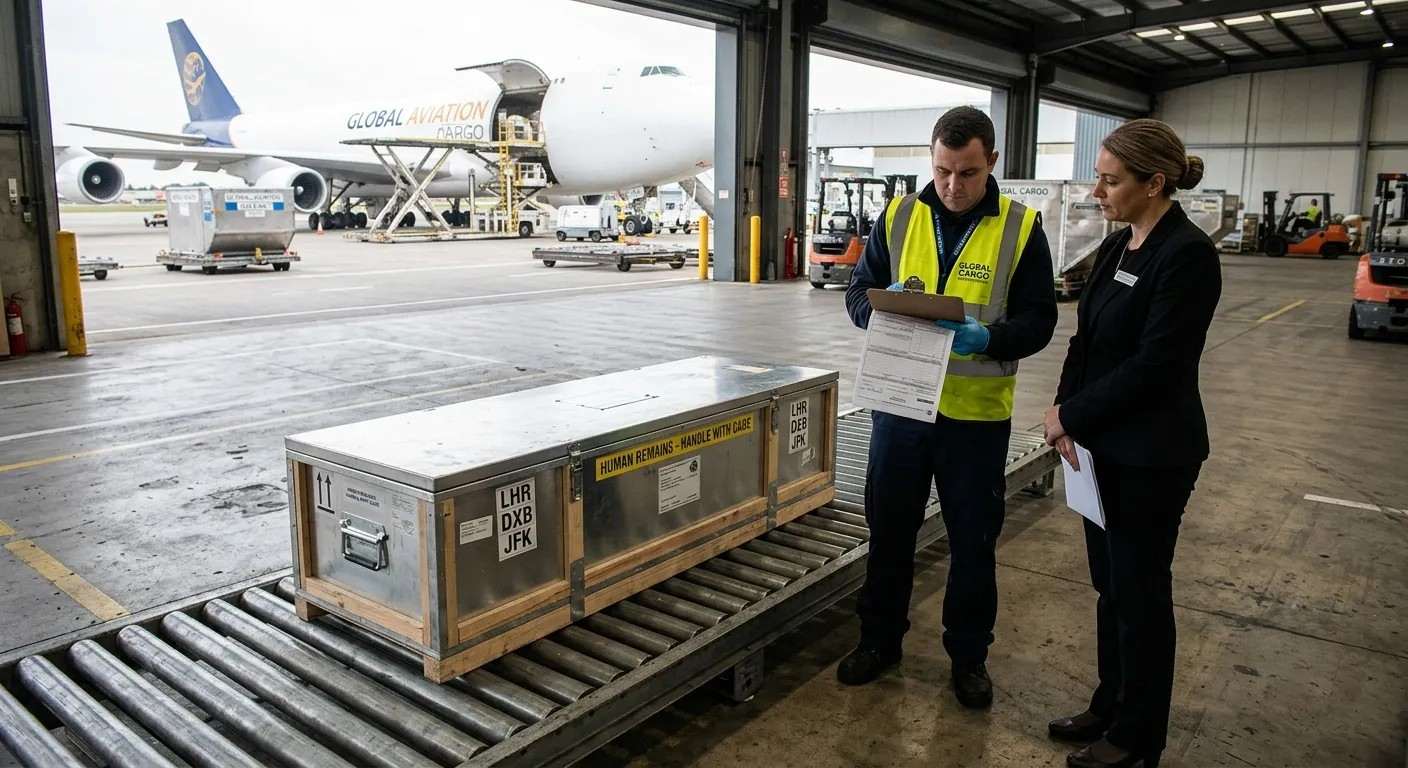
Losing a loved one abroad is painful enough without having to navigate the logistics of bringing them home. Repatriating a deceased person by air, known in the airline world as shipping Human Remains or HUM cargo, involves coordinated steps between a funeral home, the airline’s cargo or compassionate department, and government authorities at both the origin and destination. This guide explains exactly how to book cargo space for a body on an international flight, the paperwork needed, and which official portals to use.
1. Understand How Human Remains Are Classified
Airlines do not treat a deceased body like ordinary luggage. Under the International Air Transport Association rules, human remains fall under a special cargo category and must travel in a hermetically sealed inner casket placed inside a strong outer crate marked Human Remains. Only licensed funeral directors or their appointed agents, working as a known shipper, can book this cargo. Passengers cannot simply walk up to an airline counter and check in a casket the way they would a suitcase.
IATA publishes a Compassionate Transportation Manual that lists country-specific rules, airline compassionate desks, and a standard acceptance checklist used worldwide.
2. Get the Death Certificate and Local Permits First
Before any airline will discuss a booking, you need official proof of death from the local authority where the person died. This typically includes:
- A certified death certificate from the hospital, coroner or local registrar
- A police report if the death was accidental or unnatural
- A burial transit permit or transfer permit from the local health department
- A funeral home or mortuary affidavit confirming embalming
These documents form the foundation for every later step, including the embassy clearance and the airline’s own paperwork.
3. Arrange Embalming and Airline Approved Packaging
Most countries and airlines require the body to be embalmed before air transport, since the casket will be sealed for the entire journey. The standard packaging is a hermetically sealed zinc lined inner coffin placed inside a strong wooden or fibreboard outer case. Used coffins are never accepted. The funeral home issues an embalming certificate and, where required, a non contagious disease certificate confirming the deceased did not die from a notifiable infectious disease.
If the cause of death involved certain infectious diseases, additional permits or cremation may be mandatory rather than optional, so confirm this with the funeral home and the destination country’s health authority early.
4. Obtain the No Objection Certificate from the Embassy or Consulate
This is the step that most often determines how quickly the body can travel. The embassy or consulate of the deceased’s home country, located in the country where death occurred, issues a No Objection Certificate, sometimes called a laissez passer, once it receives the death certificate, embalming certificate, passport copy and consent letter from the next of kin.
Without this clearance, no international airline will accept the shipment, since customs and immigration at the destination will refuse the consignment on arrival.
5. Contact the Airline’s Cargo or Compassionate Department
Once the death certificate, embalming certificate and embassy NOC are in hand, the funeral director or a repatriation agent contacts the airline directly. Most major international carriers run a dedicated desk for this, separate from regular passenger or cargo booking:
- Most full service international carriers operate a dedicated human remains or compassionate cargo desk reachable by phone or a specific email address
- Funeral homes typically request a quote, confirm cargo hold space and weight limits, and lock in a flight date
- Airlines generally ask for 48 to 72 hours notice before the flight to verify documentation and confirm hold space
- Most carriers allow only one casket per flight and require it to travel as standalone cargo, never consolidated with other freight, live animals or food
Booking cargo space is therefore not done through a normal flight ticketing website. It goes through the airline’s cargo division, usually arranged by the funeral home, a repatriation specialist, or a freight forwarder acting as the known shipper on the airline’s behalf.
6. Prepare the Final Documentation Set
Airlines and customs at both ends typically expect the following bundle of documents to travel with the shipment or be submitted digitally in advance:
- Certified death certificate, translated into English if issued in another language
- Embalming certificate and non contagious disease certificate
- No Objection Certificate or laissez passer from the relevant embassy or consulate
- Consent letter from the next of kin for transportation
- Cancelled passport of the deceased, or a copy with cancellation noted
- Certificate confirming the casket contains only the human remains described in the paperwork
- Airline specific human remains acceptance form and the air waybill
Keep both originals and several photocopies, since airline check in staff, customs officers at transit points, and the receiving funeral home at the destination may each need a set.
7. Confirm the Air Waybill, Routing and Arrival Handling
Once the airline accepts the booking, it issues an air waybill, the cargo equivalent of a flight ticket, which carries a tracking number the family can use to follow the shipment. Choose direct flights wherever possible, since transfers between aircraft increase handling time and the risk of delay. A receiving funeral home or agent should be arranged at the destination airport to collect the remains, complete customs clearance and forward the casket to its final destination.
8. Budget for Cost and Timeline
Total cost depends on distance, airline, casket weight, embalming, and local agent fees, and can range widely, often from a little over a thousand dollars on short regional routes to several thousand dollars on long haul intercontinental routes. Natural deaths with complete paperwork are usually processed within a few days. Deaths under police investigation, or those requiring additional forensic clearance, can take two to four weeks or longer, particularly in Gulf and Middle Eastern countries, since local authorities must close their case file before releasing the body.
Always verify current requirements directly with the relevant embassy, consulate or airline cargo desk, since country rules and airline policies change and the final say on acceptance rests with the carrier and the receiving country’s customs authority.
Conclusion
Booking cargo space for a body on an international flight involves much more than reserving a seat on an aircraft. From obtaining death certificates and embalming documentation to securing embassy clearances, airline approvals, and customs paperwork, every step must be completed accurately to ensure a smooth and dignified repatriation process. While the requirements can seem overwhelming during an already difficult time, working with experienced professionals can help families avoid delays, compliance issues, and unnecessary stress.
If you need assistance with international body repatriation, Harmony International provides end-to-end support, including documentation, embassy coordination, airline cargo booking, customs clearance, and transportation arrangements. Our experienced team helps families navigate the entire process with care, professionalism, and compassion, ensuring your loved one is brought home safely and respectfully.
Frequently Asked Questions
Can a family member book cargo space for a body directly with the airline?
Usually not. Airlines require the booking to be made by a licensed funeral director, repatriation agent or freight forwarder registered as a known shipper, because of the specialised packaging, documentation and dangerous goods handling rules involved. Families work through a funeral home, which then coordinates with the airline’s cargo desk.
How far in advance should cargo space be booked?
Most airlines ask for at least 48 to 72 hours notice once all documents are ready, though embassy clearance and embalming can take longer, especially for unnatural deaths under investigation. It is wise to start the embassy NOC process as soon as the death certificate is issued.
What documents are absolutely required for international transport of a body?
At minimum: a death certificate, embalming certificate, No Objection Certificate from the relevant embassy or consulate, next of kin consent letter, the deceased’s passport, and the airline’s human remains acceptance form. Some countries add a police report or a non contagious disease certificate.
Can cremated remains be sent the same way as an uncremated body?
No. Cremated remains travel in a sealed urn, often as checked or carry on baggage on passenger flights, with far simpler paperwork such as a death certificate and cremation certificate. An uncremated body must travel as cargo in a sealed casket and follow the full human remains cargo process described above.
Who pays if the family cannot afford the cost of repatriation?
Many countries’ embassies can assist on a means tested basis if no relative or friend is able to arrange or fund the transport, though this varies by country and circumstance. It is best to raise this directly with the embassy or consulate handling the case.
Does every airline accept human remains as cargo?
No. Some low cost and regional carriers, including a few budget airlines, do not accept human remains shipments at all and only allow cremated remains as passenger baggage. Always confirm directly with the specific airline’s cargo or compassionate department before assuming a route is available
Pages You Might Like:
UK repatriation services, Destinations We Repatriate, Into the UK, What to do when someone dies, Coffins we offer
 Call us
 Email us