



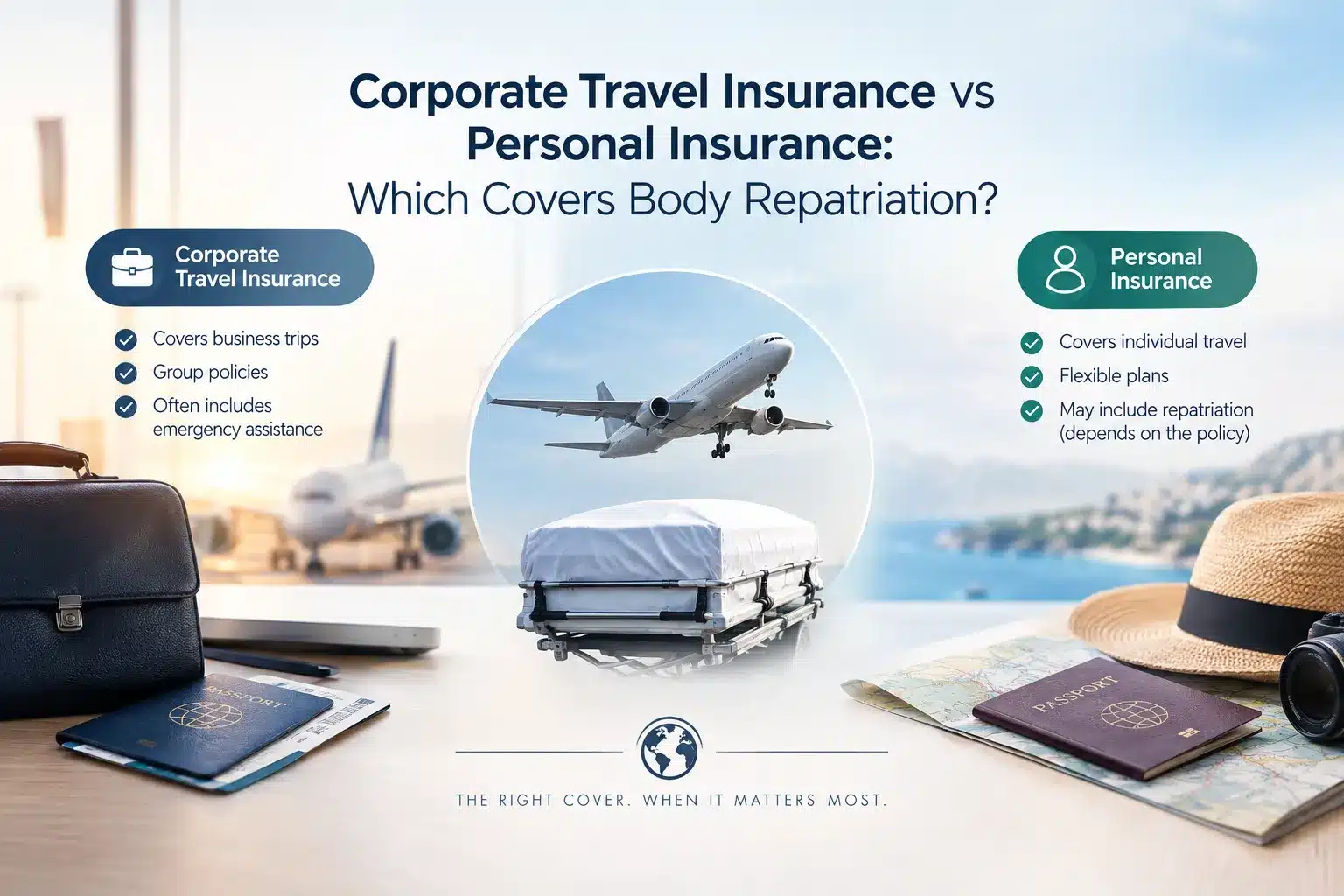
Both corporate travel insurance and personal travel insurance typically include repatriation cover, but the scope, limits, and who actually arranges it can differ significantly. Corporate travel insurance, often called business travel accident insurance, is bought by an employer and usually comes with higher cover limits, tied closely to the company’s legal duty of care toward its staff. Personal travel insurance is bought by an individual for leisure or personal trips, generally has lower limits, and applies much stricter exclusions around pre-existing medical conditions. This guide compares the two directly, explains which one applies when someone dies while travelling for work, and sets out what families should check first.
The Short Answer
If the death occurred during a work trip, the employer’s corporate travel insurance is usually the primary policy responsible for repatriation costs, since the trip itself falls within the employer’s legal duty of care. If the death occurred during a personal or leisure trip, a personal travel insurance policy is the one that applies, and repatriation cover depends entirely on whether any relevant medical conditions were declared and accepted at the time the policy was purchased.
What Corporate Travel Insurance Typically Covers
Corporate, or business travel accident, policies are designed around the specific risks of work travel and are usually purchased by the employer to cover some or all of their workforce under a single policy.
- Accidental death and dismemberment cover, often with limits between one hundred thousand and one million pounds or more.
- Emergency medical evacuation and repatriation of remains, arranged and paid for directly by the insurer.
- Twenty four hour assistance services covering medical coordination, translation support, and emergency travel logistics.
- Cover that applies specifically while the employee is travelling in the course of their employment, not personal time abroad.
What Personal Travel Insurance Typically Covers
Personal travel insurance is bought individually for a specific trip or an annual multi trip policy, and is built around holiday and leisure risks rather than employment related travel.
- Repatriation of remains as a standard benefit alongside emergency medical treatment and evacuation cover.
- Lower overall cover limits compared with most corporate policies, often in the tens of thousands of pounds.
- Strict exclusions for undeclared pre-existing medical conditions, which can void a repatriation claim entirely.
- Cover that applies to the individual policyholder and any named family members included on the same policy.
The Key Difference: Accident Cover Versus Illness Cover
One distinction families often miss is that many corporate travel policies are built primarily as accidental death and dismemberment, or AD&D, cover, which pays out specifically for accidental death rather than death from illness. A separate, more comprehensive corporate travel medical policy is usually needed to cover repatriation following a death from natural causes or illness during a business trip. Personal travel insurance policies are generally broader in this respect, covering both accident and illness related repatriation as standard, provided any relevant condition was properly declared. Families should check exactly which type of corporate policy an employer holds, since a pure AD&D policy will not respond to every cause of death.
Does a Business Trip Death Trigger Employer Duty of Care Obligations
Under the Health and Safety at Work etc. Act 1974, UK employers have a legal duty to take reasonable steps to protect employees, and this duty extends to business travel abroad. This principle was tested directly in Dusek v StormHarbour Securities LLP, where the High Court found an employer liable after failing to properly risk assess a dangerous work related helicopter journey that resulted in an employee’s death. While UK law does not specifically require an employer to hold travel insurance, most responsible employers maintain a corporate travel policy precisely because it is one of the clearest ways to demonstrate that duty of care obligations, including support with repatriation costs, have been properly met.
Which Policy Pays First When Someone Dies Abroad on a Business Trip
When a death occurs during a work trip, the corporate travel policy is normally treated as the primary source of repatriation cover, since the trip was undertaken in the course of employment. If the employee also held a personal annual travel policy, this would not usually apply at the same time, since most personal policies exclude claims connected to paid work travel. Where a corporate policy has a lower repatriation limit than the actual cost involved, or where cover turns out to be narrower than expected, families should ask the employer directly whether the company will cover any shortfall separately, since this is often addressed informally as part of the employer’s broader duty of care response.
What Families Should Actually Do
- Contact the employer’s HR or travel management team immediately to confirm which corporate policy applies and its policy number.
- Ask specifically whether the corporate policy is AD&D only or includes full medical and illness related repatriation cover.
- Check whether the deceased also held a personal travel insurance policy, and read its business travel exclusions carefully.
- Request the insurer’s twenty four hour emergency assistance number, since most repatriation policies include direct support.
- Instruct a specialist repatriation provider straight away, since practical arrangements do not need to wait for a claim to be finalised.
Getting Repatriation Underway While Insurance Is Confirmed
Insurance claims, whether corporate or personal, take time to process fully, but repatriation logistics such as documentation, coroner clearance, and flight booking can and should begin straight away. Harmony International works directly with employers, HR teams, and insurers to coordinate repatriation while a claim is still being confirmed, so families are not left waiting.
If your family or organisation needs support with repatriation now, contact Harmony International for twenty four hour assistance, or request a free quote to understand costs while insurance details are being confirmed.
Frequently Asked Questions
Does corporate travel insurance automatically cover repatriation?
Most corporate travel policies include repatriation cover, but families should confirm whether the policy is accident only or also covers death from illness.
Is personal travel insurance enough for a work trip abroad?
Usually not, since most personal policies exclude claims connected to paid work travel, meaning the employer’s corporate policy should apply instead.
What is the difference between AD&D and full corporate travel medical cover?
AD&D pays out specifically for accidental death, while a full corporate travel medical policy also covers repatriation following death from illness or natural causes.
Are UK employers legally required to provide repatriation cover for business trips?
There is no specific legal requirement to hold travel insurance, but employers have a broader duty of care under UK health and safety law that most meet through corporate travel cover.
Which policy pays if an employee dies of an illness rather than an accident on a business trip?
This depends on the exact policy. A pure AD&D policy will not pay for illness related death, so a comprehensive corporate travel medical policy or employer support may be needed instead.
Who arranges repatriation logistics after a corporate travel insurance claim is confirmed?
Insurers often work with a specialist repatriation provider directly. Harmony International regularly coordinates with employers and insurers to manage documentation, embassy liaison, and transport arrangements.
 Call us
 Email us