



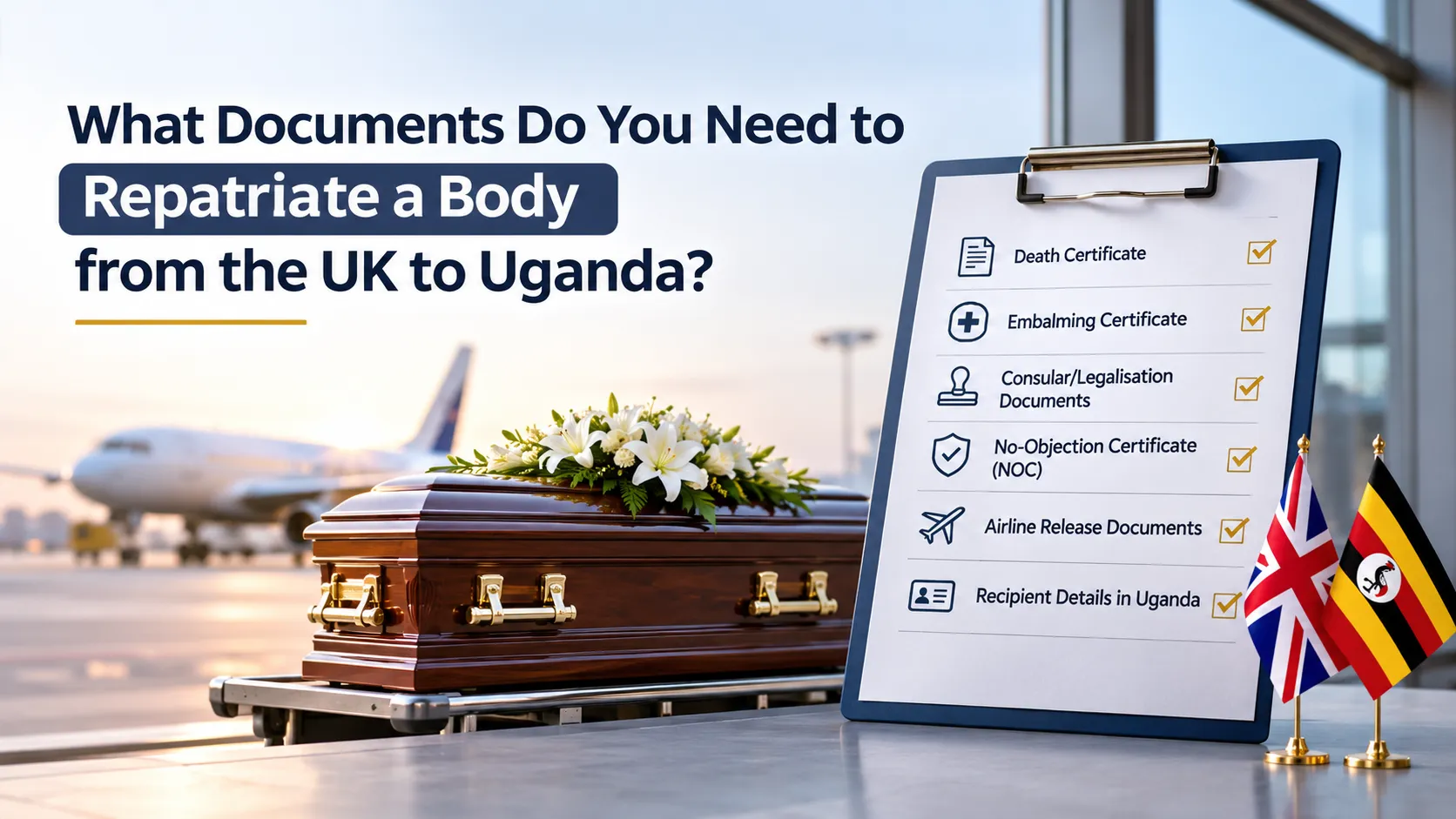
Losing a loved one is hard enough without a pile of forms to complete. When the funeral is to take place in Uganda, the paperwork has to satisfy two sets of authorities: the registrar and coroner in the UK, and the Ugandan authorities who decide whether the remains can enter the country.
This guide explains every document needed to repatriate a body from the UK to Uganda, who issues it, and the order in which to collect it. It covers deaths in England and Wales. Scotland and Northern Ireland have their own procedures, so check with the local registrar there.
How Does Repatriation from the UK to Uganda Work?
The process follows a fixed order, and each stage depends on the one before it:
- A doctor issues the medical certificate.
- The death is registered and certificates are issued.
- The coroner receives notice and grants permission to remove the body.
- The body is embalmed and health certificates are issued.
- A Ugandan mission certifies the documents.
- The airline accepts the remains and the flight is booked.
- The remains are cleared and collected at Entebbe.
Skipping a stage, or doing them out of order, is the most common cause of delay. The sections below explain each one.
Step 1: Obtain the Medical Certificate of Cause of Death
The doctor who cared for the person issues the Medical Certificate of Cause of Death. In England and Wales, a medical examiner reviews it before it is released. The registrar cannot register the death without it, and everything else depends on registration.
If the death was sudden, unexpected or unexplained, the doctor refers it to the coroner instead. In that case the coroner may order a post-mortem or open an inquest, and the timeline changes. See the section on coroner investigations below.
Step 2: Register the Death and Order Death Certificates
A death in England and Wales must be registered within five days of the register office receiving the medical certificate from the medical examiner, including weekends and bank holidays, unless the coroner is involved. You can register at the office for the district where the death occurred, or make a declaration at another office. Use GOV.UK to register a death and to find a register office.
The registrar may ask to see some of the following:
- Birth certificate of the deceased
- Passport or driving licence
- Marriage or civil partnership certificate
- NHS medical card and any council tax bill
Registration itself is free, but each certified copy of the death certificate costs roughly £12. Order several copies at the start. You will need originals or certified copies for the coroner, the Ugandan mission, the funeral director and later for the estate. More copies can be requested later through GOV.UK’s certificate ordering service. After registering, you can notify most government bodies at once through Tell Us Once.
Step 3: Notify the Coroner and Obtain Permission to Remove the Body
Even when the death was natural, the law requires notice to the coroner before a body leaves England and Wales. There is no restriction on moving a body within England and Wales, but moving it abroad needs the coroner’s authority. Read GOV.UK’s guidance on deaths reported to a coroner for background.
The funeral director normally handles the application. The usual documents are:
- Form 104, the notice to the coroner of intention to remove a body out of England
- A two-page application for removal of a body out of the country, supplied by the funeral director
- The deceased’s passport
- The passport of the person making the application
- A doctor’s identification certificate
- The death certificate, unless the coroner is investigating the death
If everything is in order, the coroner issues Form 103, which authorises removal. Many coroners return it within one to two working days of receiving Form 104. The law, however, requires a set number of clear days after notice (four or five, depending on the form version) unless the coroner agrees to an earlier removal in an urgent case. Do not book flights until your funeral director holds Form 103.
Step 4: Prepare Identity Documents
The Ugandan mission asks for the original passport of the deceased, so keep it safe and hand it to the funeral director. You should also have your own photographic identity ready, as the coroner and funeral director need to confirm who is applying.
The passport should be cancelled once it is no longer needed for repatriation. Complete the D1 form with His Majesty’s Passport Office to prevent identity fraud. Do this after the remains have been repatriated, not before.
Step 5: Arrange Embalming and Health Certificates
International carriage by air generally requires embalming, so a licensed embalmer prepares the body and issues a certificate of embalming. Ugandan missions also list these health and medical documents:
- Certificate of no contagious diseases
- Post-mortem report, or a comprehensive medical report from the attending doctor or health facility
If the person had an infectious condition, tell the funeral director at the outset so that the correct precautions and paperwork are arranged. Delays at this stage are rarely about the form itself. They usually come from waiting for a doctor to complete and sign the medical report.
Step 6: Get the Documents Certified by a Ugandan Mission
Ugandan embassies and high commissions certify the documents that accompany remains to Uganda. As an example, the Embassy of Uganda in Rome lists these original documents for a burial:
- A signed letter of request for certification from a responsible person, such as a relative or employer
- The passport of the deceased
- The death certificate
- The certificate of embalmment
- A burial permit from the local authority where the deceased resided
- A certificate of no contagious diseases
- A post-mortem report or comprehensive medical report
The embassy states that certification is free and takes one to three working days. Documents sent by post must be originals, with a prepaid return envelope. The Ugandan consulate in Mombasa publishes similar guidance. Because each mission sets its own list, contact the Uganda High Commission in London through the Ministry of Foreign Affairs of Uganda to confirm exactly what it will accept, including which UK document it treats as the burial permit. Your funeral director can advise on this.
Step 7: Complete Airline and Arrival Paperwork
The airline advises on the casket and its requirements. The funeral director books the cargo, prepares the airway bill and places the documents in a sealed folder that travels with the remains. Every airline sets its own acceptance rules, so check them early.
On arrival at Entebbe, a Ugandan funeral home or family representative clears the remains with the airport and customs authorities. The Uganda Revenue Authority handles customs, and health officials may inspect the documents. Having a Ugandan funeral home lined up before the flight avoids storage costs and confusion on the ground.
Master Checklist: Documents for Repatriation to Uganda
| Document | Issued by | Purpose |
|---|---|---|
| Medical Certificate of Cause of Death | Doctor and medical examiner | Allows registration |
| Death certificate | Register office | Proof of death for all authorities |
| Form 104 | Funeral director or registrar | Notice to the coroner |
| Form 103 | Coroner | Permission to remove the body |
| Deceased’s passport | HM Passport Office or Ugandan authorities | Identity and mission certification |
| Certificate of embalming | Licensed embalmer | Airline and Ugandan requirement |
| Certificate of no contagious diseases | Doctor or health authority | Ugandan requirement |
| Post-mortem or medical report | Hospital or pathologist | Ugandan requirement |
| Burial permit and request letter | Local authority and next of kin | Mission certification |
| Airway bill | Airline and funeral director | Cargo transport |
What About Cremation and Ashes?
Ashes are easier to transport than a body, and the paperwork is lighter. Typically you need the death certificate, the crematorium’s certificate of cremation and a statement that the container holds only the cremated remains. Confirm the airline’s rules, as some allow ashes in hand luggage and others require cargo.
If you plan to cremate in Uganda after transporting a body, the Ugandan mission asks for a signed request letter endorsed by the local authority, the deceased’s passport, the death certificate with a post-mortem report, and the contact details of the funeral home handling the cremation.
What If the Coroner Is Investigating the Death?
When a death is referred to the coroner, registration and removal wait until the coroner finishes. A post-mortem may be needed, and in some cases an inquest. The coroner will not normally issue Form 103 while enquiries are open.
Keep the coroner’s office informed that the family intends to repatriate, and ask for the post-mortem report early, since the Ugandan mission asks for it. Your funeral director can liaise with the coroner’s officer so that nothing is missed.
Common Mistakes That Delay Repatriation
- Booking flights before Form 103 has been issued
- Ordering too few certified copies of the death certificate
- Sending photocopies to the Ugandan mission when originals are required
- Name or date mismatches between the passport and the death certificate
- Forgetting the certificate of no contagious diseases
- Leaving airline acceptance checks until the last moment
- Not arranging a Ugandan funeral home before arrival
Timelines vary with coroner workload, mission turnaround, post-mortem requirements and flight availability, so plan for the process to take longer than expected.
Frequently Asked Questions
- Can I repatriate a body to Uganda without a death certificate?
No. The coroner will not normally authorise removal until the death is registered and a certificate is issued, unless the coroner is investigating the death. The Ugandan mission also needs the certificate.
- Do I need the coroner’s permission if the death was natural?
Yes. Notice to the coroner is required for any removal of a body out of England and Wales, whatever the cause of death.
- Is embalming compulsory?
International air carriage generally requires it, and Ugandan missions ask for the embalming certificate. Check with your funeral director and the airline.
- Can I carry ashes to Uganda myself?
Often yes, but check the airline’s policy first and carry the death certificate and the certificate of cremation. A funeral director can arrange transport if you prefer.
- Who pays for repatriation?
The family usually pays, though a funeral plan, insurance policy, employer or community association may contribute. Ask for a written quote that lists every charge.
- How do I find a repatriation provider?
The Foreign, Commonwealth and Development Office publishes a list of UK-based international funeral directors. Choose one with direct experience of Uganda.
Let Specialists Carry the Paperwork
Repatriating a body from the UK to Uganda involves a medical certificate, registration, coroner’s permission, embalming and health certificates, Ugandan mission certification and airline arrangements. Each document has a purpose and a deadline, and the order matters. Gather originals, order extra certified copies, never book flights before Form 103, and confirm current requirements with the coroner and the Ugandan mission.
You do not have to manage this alone. Harmony International provides compassionate and dignified repatriation services across the UK, including secure international transportation, airline coordination and final arrangements. Contact Harmony International today to speak with a team that will guide your family through every document and every step, so you can focus on saying goodbye.
 Call us
 Email us