



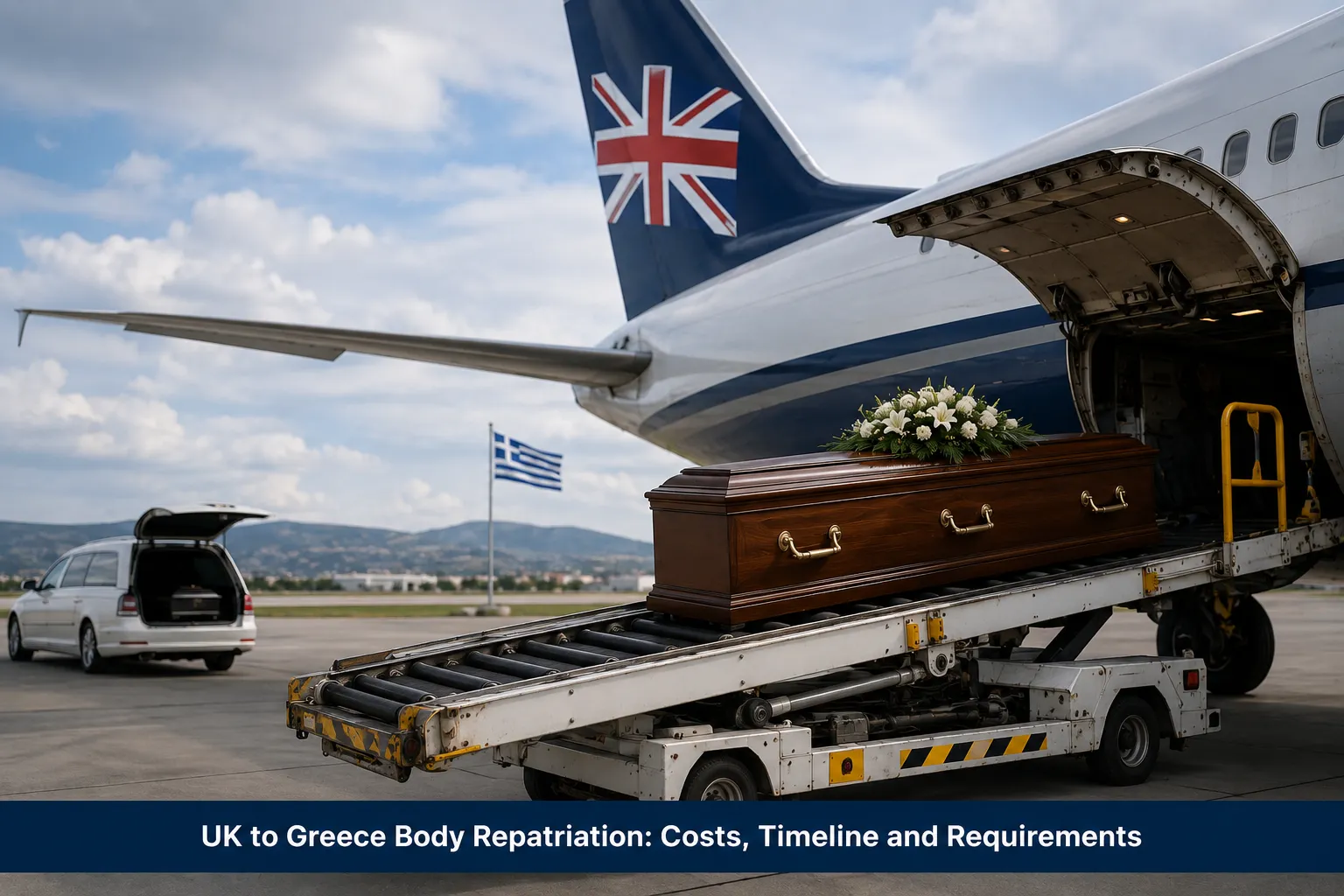
When a British national dies in Greece, the family left behind is suddenly faced with an unfamiliar process at the worst possible time. Body repatriation from Greece to the UK involves Greek local authorities, a Greek funeral director, a UK based repatriation specialist, and several government bodies on both sides of the journey. This guide explains, in plain terms, what repatriation actually involves, what it costs, how long it takes, and which documents are required, so families can make informed decisions quickly and with confidence.
Quick Answer: Cost and Timeline at a Glance
Repatriating a body from Greece to the UK generally takes between 8 and 14 days from the date of death, once the death is registered and no post mortem investigation is required. Costs typically start from around £2,500 when a standard repatriation service fee is combined with flight costs, though bespoke arrangements, upgraded coffins, and additional third party charges can raise this figure considerably. The process requires a Greek death certificate, a medical certificate of death, an embalming certificate, and the deceased’s British passport, alongside close coordination between a Greek funeral director and a UK repatriation specialist.
What Is Body Repatriation from Greece to the UK?
Body repatriation is the formal process of returning a deceased person’s body from the country where they died to their home country for burial or cremation. When someone dies in Greece, their next of kin can choose between arranging a local funeral in Greece or bringing the body home to the UK. Repatriation covers everything required to make that journey possible, including collection of the deceased, full embalming, a suitable coffin, completion of legal documents, transport to the departure airport, airfreight, and customs clearance on arrival in the UK.
Most families choose a dedicated repatriation service from the UK to Greece, because it consolidates a legally complex, cross border process into a single, manageable point of contact rather than leaving the family to coordinate several separate providers themselves.
Step by Step: How the Repatriation Process Works
The exact sequence can vary slightly depending on the circumstances of the death, but a standard repatriation from Greece to the UK generally follows these stages.
- The death is reported to the local police or hospital, and to the British Embassy, High Commission or Consulate in Greece if this has not already happened.
- The death is registered at the local Greek registry office, known as the dimos, usually within thirty days of the date of death.
- The deceased is collected by a licensed Greek funeral director, who prepares the body for the journey home to the UK.
- Full embalming takes place, which is required for repatriation because the body must meet international air transport standards.
- The body is placed inside a certified, zinc lined coffin, which customs officials inspect and formally seal before departure.
- All necessary legal documents are completed, including the death certificate, embalming certificate, and any required consular paperwork.
- A flight back to the UK is arranged, and the coffin is conveyed to the appropriate airport of departure in Greece.
- The coffin travels as airfreight to the UK, followed by customs clearance and collection at the UK airport of arrival.
- Finally, the coffin is conveyed to a funeral director of the family’s choice in the UK, ready for burial or cremation.
What Documents Are Required to Repatriate a Body from Greece?
Several official documents must be gathered before a body can legally leave Greece and be accepted back into the UK. A specialist repatriation company will usually manage most of this paperwork on the family’s behalf, working directly with local authorities and the funeral director in Greece.
- The Greek death certificate, known locally as the ληξιαρχική πράξη θανάτου, issued once the death is registered with the local municipality.
- A medical certificate of death from the attending doctor or hospital, confirming the cause of death where this is already known.
- A certificate of embalming confirming the body has been prepared to the standard required for international transport home.
- A certificate confirming the body is free from infectious disease, sometimes referred to as a mortuary or health certificate.
The deceased’s British passport, which under official UK government guidance should not be cancelled until after the body has actually been repatriated to the UK.
- Formal permission to remove the body, issued by the relevant Greek authority once local formalities have been completed in full.
- An English translation of the Greek death certificate, which most repatriation companies and funeral directors can arrange for the family.
How Much Does UK to Greece Body Repatriation Cost?
There is no single fixed price for repatriation, because costs depend on flight availability, the departure city in Greece, the level of embalming and coffin required, and whether any additional services are requested. As a general guide, a standard repatriation service from Greece to the UK begins from around £1,750, which covers collection, embalming, the coffin, legal documentation, and transport arrangements at the UK end.
Flights from Athens to the UK typically add a further £750 or more, depending on the season, route, and available capacity at short notice. Combined, most straightforward repatriations therefore start from roughly £2,500, though this rises where a bespoke package is needed, for example if the family wants to choose a specific coffin style or hold a UK service before the body is formally repatriated, in which case pricing is quoted on application rather than fixed in advance.
- A standard repatriation service fee, covering collection, embalming, the coffin, documentation, and onward transport arrangements in the UK.
- Flight or airfreight costs from Greece to the UK, which vary by departure city, airline capacity, and time of year.
- An optional upgraded coffin, chosen by the family in place of the standard repatriation coffin included as standard.
- Bespoke package costs, including a UK based service held before repatriation, which are priced individually on application.
It is worth checking whether the deceased held travel insurance before assuming the family must cover these costs alone, since many policies contribute toward repatriation expenses.
How Long Does Repatriation from Greece to the UK Take?
Local formalities in Greece normally take between 8 and 10 days to complete, according to UK government guidance on deaths in Greece, meaning most straightforward repatriations can bring a body home within one to two weeks of the date of death.
This timeline depends heavily on the cause of death, whether an autopsy is required, local public holidays, and how quickly documents can be issued and translated. Under Greek law, burial or cremation should generally take place within one month of death, though local authorities usually allow foreign nationals additional time when the body is being repatriated rather than buried locally. Families should treat the 8 to 14 day window as a realistic average rather than a guarantee, since island locations and remote regions can add a few extra days to transport arrangements.
Will There Be a Post Mortem, and Does It Affect the UK Coroner Process?
A post mortem in Greece is not automatic, but it becomes mandatory when the cause of death is unclear, sudden, or violent, and it is carried out by a court appointed pathologist at the request of the Greek police. This can extend the timeline beyond the usual 8 to 14 days, since the body is not released for repatriation until the examination is complete.
Once the body returns to the UK, a coroner in England or Wales may open a further investigation if the death was unnatural or the cause was never established, though embalming carried out in Greece can limit what a second post mortem is able to determine. Families who anticipate a UK coroner’s inquest should raise this with their repatriation company early, since it directly affects decisions such as cremation abroad, which should be avoided if a UK inquest is likely to follow.
Does Travel Insurance Cover Repatriation Costs?
If the person who died held valid travel insurance, the policy may cover some or all of the repatriation costs, along with related medical, legal, interpretation, and translation fees, so the family should contact the insurer as soon as possible after the death. It is worth noting that the Foreign, Commonwealth and Development Office does not pay for burial, cremation, or repatriation expenses, so families without valid insurance cover need to budget for these costs directly or discuss staged payment arrangements with their chosen repatriation company.
Get Support with UK to Greece Repatriation
Bringing a loved one home from Greece involves a great deal of paperwork, several government bodies, and a tight timeline, and no family should have to navigate it alone. Harmony International handles every stage of the process, from the first phone call in Greece through to collection by a UK funeral director of your choice, so you can focus on your family rather than logistics.
Speak to Harmony International’s team, available 24 hours a day, 7 days a week, on (+44) 2030 264 464, or request a free repatriation quote online and let a dedicated coordinator guide you through repatriation from Greece to the UK with care, clarity, and respect. You can also read more about our coffin requirements and our full range of repatriation services out of the UK before you get in touch.
Frequently Asked Questions
How much does it cost to repatriate a body from Greece to the UK?
Standard repatriation packages typically start from around £2,500, combining the repatriation service fee and flight costs. Bespoke coffins, additional services, or a UK service held before repatriation will raise this figure, so a personalised quote is the only way to confirm exact costs for a specific case.
How long does it take to bring a body home from Greece?
Local formalities in Greece usually take 8 to 10 days to complete, so most straightforward repatriations bring the deceased back to the UK within one to two weeks of death, provided no post mortem or additional investigation is required.
What documents do I need to repatriate a body from Greece?
You will typically need the Greek death certificate, a medical certificate of death, an embalming certificate, a certificate confirming freedom from infection, and the deceased’s passport. A repatriation specialist will usually gather these documents on your behalf.
Is embalming required before repatriation from Greece?
Yes. Embalming is a standard requirement before a body can be transported internationally by air, and Greek funeral directors are equipped to carry out this process to the standard required for repatriation to the UK.
Does travel insurance cover the cost of repatriation?
It often does. Many travel insurance policies cover repatriation along with related medical, legal, and translation costs, so contacting the insurer immediately after the death is one of the most important early steps a family can take.
Will a coroner investigate the death once the body is back in the UK?
A coroner in England or Wales may investigate if the death was sudden, violent, or the cause is unclear. If an inquest is likely, cremation in Greece should be avoided so that option is not closed off.
Do I have to register the death with UK authorities as well as in Greece?
No. Registering a British national’s death overseas with UK authorities is optional, but doing so, known as consular registration, provides a UK style death certificate and a record held at the General Register Office.
Can repatriation be arranged from smaller towns in Greece, or only major cities?
Yes. Harmony International coordinates with local funeral directors across Greece, including smaller towns and islands and not only Athens, so location alone should not limit a family’s repatriation options.
Pages You Might Like:
UK repatriation services, Destinations We Repatriate, Into the UK, What to do when someone dies, Coffins we offer
 Call us
 Email us