



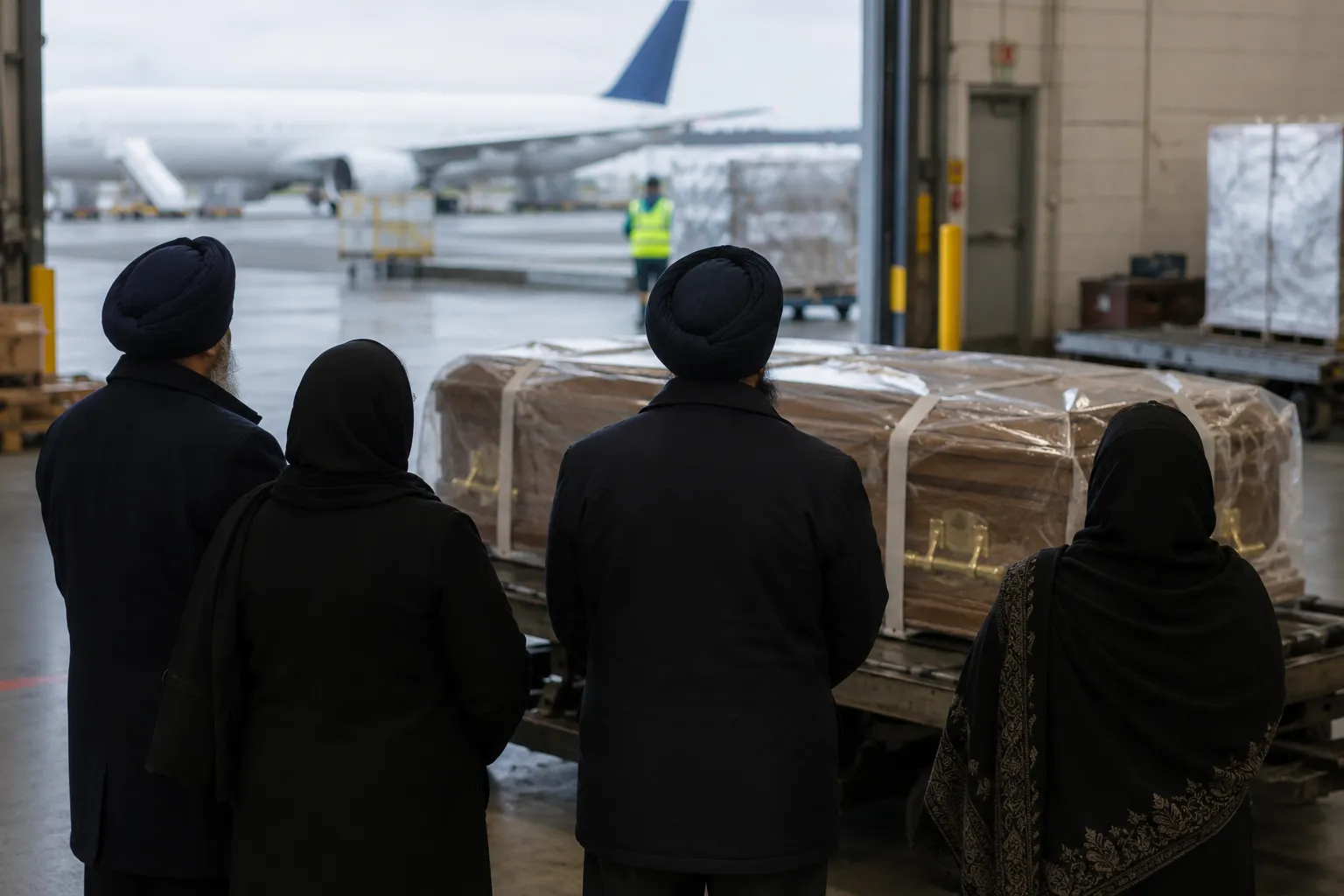
For many Sikh families in the UK, the wish that a loved one should be returned to Punjab, or to another part of India, for their final rites is deeply felt and spiritually significant. The rivers and sacred sites of Punjab carry a particular meaning for the scattering of ashes. The extended family, the ancestral village, the local Gurdwara: these form a geography of belonging that makes repatriation not simply a logistical preference but a profound act of cultural and religious continuity.
At the same time, international repatriation is one of the most complex and documentation-intensive funeral arrangements a family can face. It involves two sets of national authorities, multiple certificates, embassy liaison, airline freight protocols, and careful coordination between funeral directors in both countries, all managed during the first days of bereavement when grief is most acute.
This guide explains everything Sikh families in the UK need to know about repatriation, from the first steps to take when a death occurs, through the documentation required, the choice between body and ashes repatriation, and the Sikh religious considerations that shape the process.
Why Repatriation Matters to Sikh Families
Sikhism does not mandate burial in a particular location. The Guru Granth Sahib Ji teaches that the soul is eternal and that the physical body returns to the elements. Cremation is the universally practised final rite for Sikhs, and the Antam Sanskar ceremony can be performed anywhere in the world.
Yet for many UK Sikh families, particularly those with strong generational ties to Punjab, the question of where cremation takes place and where ashes are scattered carries deep significance. The Sutlej River, the Beas River, and the sacred waters at Sri Harmandir Sahib (the Golden Temple) in Amritsar are among the most meaningful sites for the immersion of ashes within the Sikh tradition. Extended family who were unable to travel to the UK may wish to be present for the cremation or for the final rites. The ancestral village, the family Gurdwara, the landscape of childhood: these create a pull toward repatriation that is entirely understandable and entirely legitimate.
For Sikh families who arrived in the UK in the 1960s and 1970s and whose roots in Punjab remain close, the expectation of repatriation is often an understood family norm rather than a decision that needs to be made. For younger generations navigating these arrangements for the first time, knowing what the process involves is essential preparation.
Body Repatriation vs Ashes Repatriation: Understanding the Options
When a Sikh family in the UK is considering repatriation, the first decision is whether to repatriate the body for cremation in India, or to arrange cremation in the UK and repatriate the ashes. Each option has different implications for cost, documentation, timeline, and the religious experience of the family.
Repatriating the Body for Cremation in India
If the family wishes the cremation itself to take place in India, allowing extended family to be present for the Antam Sanskar ceremony, the body must be embalmed, placed in a zinc-lined coffin sealed to airline freight standards, and transported by air cargo. The death must first be registered in the UK and the body released by the coroner where applicable.
This option allows the full Sikh funeral ceremony, including the lighting of the pyre or the pressing of the cremation button, to be carried out in India with all family members present. It also allows for the ashes to be immersed immediately after cremation at a locally significant river or at Amritsar, without the additional step of carrying ashes separately.
The main considerations are cost, which is significantly higher than ashes repatriation, and timeline, since the body must remain in a suitable facility while documentation is processed, which typically takes between five and ten working days.
Repatriating Ashes After Cremation in the UK
Alternatively, the family may choose to hold the Antam Sanskar ceremony and cremation in the UK, and then carry or send the ashes to India for immersion. This is a simpler process with fewer legal formalities, lower cost, and greater flexibility over timing.
Ashes can be hand-carried on a commercial flight in a sealed container with appropriate documentation, or sent via specialist courier. The Indian High Commission in London or the Consulate General in Birmingham can advise on documentation requirements for bringing ashes into India. In most cases, a letter from the crematorium confirming the cremation and the identity of the deceased, along with the UK death certificate, is sufficient.
This option is increasingly chosen by UK Sikh families, particularly where the deceased had lived in the UK for many years and where a UK-based community funeral service reflects the reality of the person’s life. A meaningful ceremony is held in the UK for the UK community, and a separate ashes immersion ceremony is held in Punjab for the Indian family.
The Documentation Required for Sikh Repatriation from the UK
Documentation is the most time-consuming part of body repatriation. Missing or incorrect paperwork causes delays that extend the time the body must remain in care, which is distressing for families and in some cases affects funeral timing. A specialist repatriation provider handles all documentation on the family’s behalf, but it is useful to understand what is required.
UK-Side Documents
- UK Death Certificate: The death must be registered at the local register office, usually within five days. The registrar issues the green certificate (Form 14) authorising the funeral, and a formal death certificate for use in official matters.
- Coroner’s Letter of No Objection: If the death was sudden, unexpected, or the cause is unclear, the coroner must be notified and may conduct an investigation before releasing the body. Even in straightforward deaths, the coroner must be informed when a body is leaving the UK.
- Embalming Certificate: The body must be professionally embalmed before repatriation. The embalming certificate confirms this has been done to the standard required by international airline freight protocols.
- Freedom from Infection Certificate (Cadaver Certificate): This confirms that the deceased did not suffer from a notifiable infectious disease. It is typically issued by a registered medical practitioner and is required by Indian authorities before the body can enter the country.
- Laissez-Passer (Out of Country Travel Document): This is the official document authorising the body to leave the UK, issued by the local registrar or coroner. It must accompany the body on the flight.
India-Side Requirements
- Indian High Commission Clearance: The Indian High Commission in London must be notified of the repatriation. The High Commission issues a No Objection Certificate (NOC) or clearance letter that must accompany the consignment.
- Consular attestation of the UK death certificate: The Indian High Commission or Consulate General in Birmingham may be required to attest the UK death certificate for it to be accepted by Indian authorities at the port of entry.
- Customs clearance at the Indian airport: A local funeral director or family representative in India must arrange customs clearance at the receiving airport and collect the coffin for onward transport to the cremation site.
The repatriation provider coordinates all of the above and liaises directly with the Indian High Commission, the airline, and the receiving funeral director in India. Families should not attempt to manage this documentation independently.
The Sikh Religious Requirements During Repatriation
Sikh tradition requires that the body be treated with respect and dignity throughout the repatriation process, in accordance with the principles of the Antam Sanskar. A repatriation provider experienced in Sikh funerals will understand the following requirements:
- The Five Ks (Panj Kakars): An initiated Sikh (Amritdhari) must remain in the Panj Kakars, the five articles of faith (Kesh, Kara, Kachera, Kangha, and Kirpan), at all times, including during embalming and transportation. The repatriation provider must be aware of this and must instruct the embalming team accordingly.
- No removal of Kesh: Under no circumstances should the hair of an Amritdhari Sikh be cut or interfered with during preparation or embalming. This applies to both men and women.
- Appropriate garments: The body should be dressed in clean white or blue clothing, in keeping with Sikh practice. Families will typically wish to have involvement in the dressing of the body, which a good repatriation provider will facilitate.
- Prayers at the time of preparation: Japji Sahib should ideally be recited when the body is being prepared. Where family members wish to be present during preparation to lead prayers, this should be accommodated.
- Gurdwara visit before repatriation: Many UK Sikh families wish to take the body to the Gurdwara for Kirtan and Ardas before it is repatriated. The timeline for documentation and embalming must allow for this, and the repatriation provider should plan accordingly.
These requirements are not optional cultural preferences. They are religious obligations that a repatriation provider must understand and respect. Families should ask directly about each of the above points when making initial enquiries.
Costs of Sikh Repatriation from the UK
Costs for body repatriation from the UK to India typically start from approximately £3,000 to £3,500 for a direct flight to a major hub such as Delhi or Amritsar, based on 2025 pricing. Final costs vary depending on the destination airport within India, the airline used, the weight and dimensions of the coffin, and any additional services required such as onward transport within India.
Ashes repatriation is considerably less expensive. Hand-carrying ashes on a commercial flight involves no specialist freight cost beyond the cost of the flight ticket. Courier repatriation of ashes via a specialist provider typically costs several hundred pounds rather than several thousand.
It is worth checking whether the deceased held travel insurance, a pre-paid funeral plan, or a repatriation rider on a life insurance policy, as these can cover some or all of the repatriation costs. Some funeral plans include repatriation as a standard element; others offer it as an optional addition. The Indian High Commission emergency line (+44 7768 765035) can also provide guidance on available support for Indian nationals who die in the UK.
What to Do First When a Death Occurs and Repatriation Is Planned
- Contact a specialist repatriation provider immediately: Repatriation requires coordination that must begin as early as possible. A specialist provider takes charge of the process from the first call.
- Register the death: The death must be registered at the local register office within five days. The funeral director will guide you through this.
- Notify the coroner: For any sudden, unexpected, or unexplained death, the coroner must be notified before the body can be released. The funeral director manages this communication.
- Contact the Indian High Commission: For Indian nationals who die in the UK, the High Commission emergency number (+44 7768 765035) is available. For all repatriations, High Commission involvement in the documentation process must be arranged.
- Inform the family in India: Family members in India will need time to prepare for customs clearance at the receiving airport, the onward transport of the body or ashes, and the funeral arrangements on arrival. Your repatriation provider can liaise directly with a local funeral director in India if needed.
- Confirm religious requirements with the provider: Ensure the repatriation provider understands and will observe all Sikh religious requirements during preparation, embalming, and transport.
International Repatriation Support from Harmony International
Sikh repatriation from the UK is a meaningful and manageable process when it is guided by a provider who understands both the logistical complexity and the religious requirements that shape it. The documentation, the airline protocols, the embassy clearances: these are all manageable with the right expertise in place. What matters most to the family, the Antam Sanskar being conducted with dignity, the Panj Kakars being respected, the ashes reaching the waters of Punjab, is entirely achievable with proper support.
Whether the family chooses body repatriation for cremation in India or cremation in the UK followed by ashes repatriation, the process begins in the same place: a first call to a specialist provider who takes on the full scope of the arrangements, leaving the family free to focus on prayer, community, and the beginning of grief.
Harmony International is a specialist repatriation services UK dedicated to the international transfer of deceased persons, both into and out of the UK. With deep expertise in Sikh and Asian funeral traditions, a multilingual team, and 24-hour availability, Harmony International manages the complete repatriation process on behalf of the family, including embassy liaison, airline coordination, documentation, and the involvement of a local funeral director at the receiving end in India.
Pages You Might Like:
UK repatriation services, Destinations We Repatriate, Into the UK, What to do when someone dies, Coffins we offer
 Call us
 Email us