



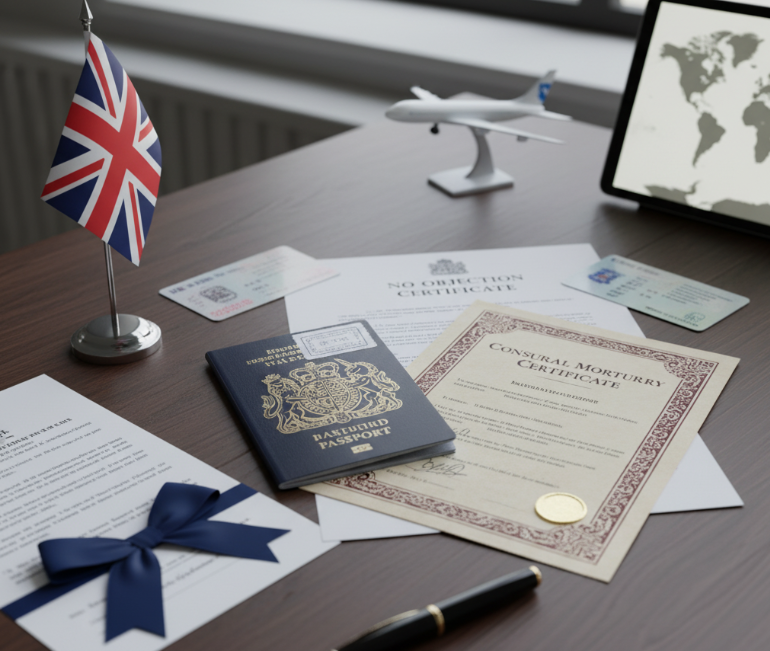
Repatriation is a sensitive and highly regulated process, requiring families and funeral directors to provide the correct paperwork before a loved one can be transported abroad. Each document plays a crucial role in meeting legal, health, and transport requirements, both in the UK and at the destination country. Below is a clear overview of the essential legal documents needed for repatriation from the UK.
Death Certificate
The death certificate is the foundation of all repatriation paperwork. It is issued by the local register office after a death has been officially recorded. Without it, no further documentation or permissions can be obtained.
Families are advised to request multiple certified copies, as different authorities, embassies, and airlines may require originals. In cases where a translation is needed, this must be arranged by an accredited translator.
Passport or Proof of Nationality
The deceased’s passport or official proof of nationality is required to confirm identity and citizenship. This ensures that the receiving country can register the death correctly and grant entry for burial or cremation. Where the passport is unavailable, alternative official identification may be accepted, but this varies by country and must be confirmed with the relevant embassy.
Coroner’s Authorisation
When a body is to be taken out of England or Wales, a coroner must grant permission through Form 104 (Notice of Removal). This process ensures that there are no outstanding investigations or legal restrictions on the body being moved.
In Scotland and Northern Ireland, different procedures apply, so it is important to check with the local authorities. Delays can occur if a post-mortem or inquest is required.
Embalming Certificate and Health Clearance
Most countries and airlines require a certificate confirming that the body has been embalmed. This helps preserve the remains during transport and complies with international health regulations.
Some destinations also request a “Freedom from Infection” certificate, particularly if the deceased passed away from an infectious disease. These documents must be prepared by a licensed funeral director or embalmer.
Export or Transit Permit
A local authority or coroner’s office issues a permit allowing the remains to leave the UK. Airlines and border authorities will not accept a coffin or urn for international transport without this authorisation. The receiving country will also expect to see this document on arrival, making it a vital part of the paperwork set.
Legalisation and Consular Requirements
Certain countries require UK-issued documents to be legalised with an apostille from the Foreign, Commonwealth and Development Office (FCDO). Others may request consular endorsement before accepting the documents.
These steps authenticate the paperwork for use abroad. Since requirements vary widely, it is always best to check with the embassy or consulate of the receiving country in advance.
Airline Documentation and Coffin Standards
Airlines follow strict regulations for transporting human remains, often based on International Air Transport Association (IATA) guidelines.
This includes the use of approved coffins, sometimes with zinc lining, and the completion of airline-specific paperwork. Without compliance, the airline may refuse to accept the coffin or urn for carriage.
Cremated Remains
If transporting ashes, the requirements differ. Typically, a cremation certificate and proof of contents are required.
Some countries impose additional restrictions, so checking embassy guidance in advance is essential. Airlines also have their own packaging and declaration rules for ashes.
Minimising Delays
Families often encounter delays due to missing paperwork, ongoing coroner investigations, or differences in international regulations.
Working with an experienced funeral director ensures all documents are in order, translations and legalisations are completed, and airline requirements are met before travel is arranged.
Conclusion
Repatriation services from the UK requires a series of legal documents, each serving a specific purpose in confirming identity, meeting health and safety standards, and ensuring compliance with UK and international law. Since requirements differ depending on the destination country, seeking expert support is the best way to avoid complications.
At Harmony International, we guide families through every step of the process, managing the documentation and liaising with embassies, coroners, and airlines. If you need assistance with repatriation from the UK, our experienced team is here to provide clear advice and complete support.
Read more in our Guide to International Repatriation Services.
 Call us
 Email us